On a Sunday in any Argentine town, the asador lights the charcoal around noon and by two o'clock a courtyard table carries ribs that have spent three hours over slow embers, alongside chorizo, morcilla and the offal cuts — achuras, chinchulines — that nowhere else receives such reverence. The ritual looks like leisure. It is also the demand base of one of the world's great protein industries: Argentines consume on the order of 50 kilograms of beef per person per year, a figure only Uruguay approaches, sustained by a national herd of roughly 50 million cattle (Cámara de la Industria y el Comercio de Carnes; IPCVA data).
The pampas equation
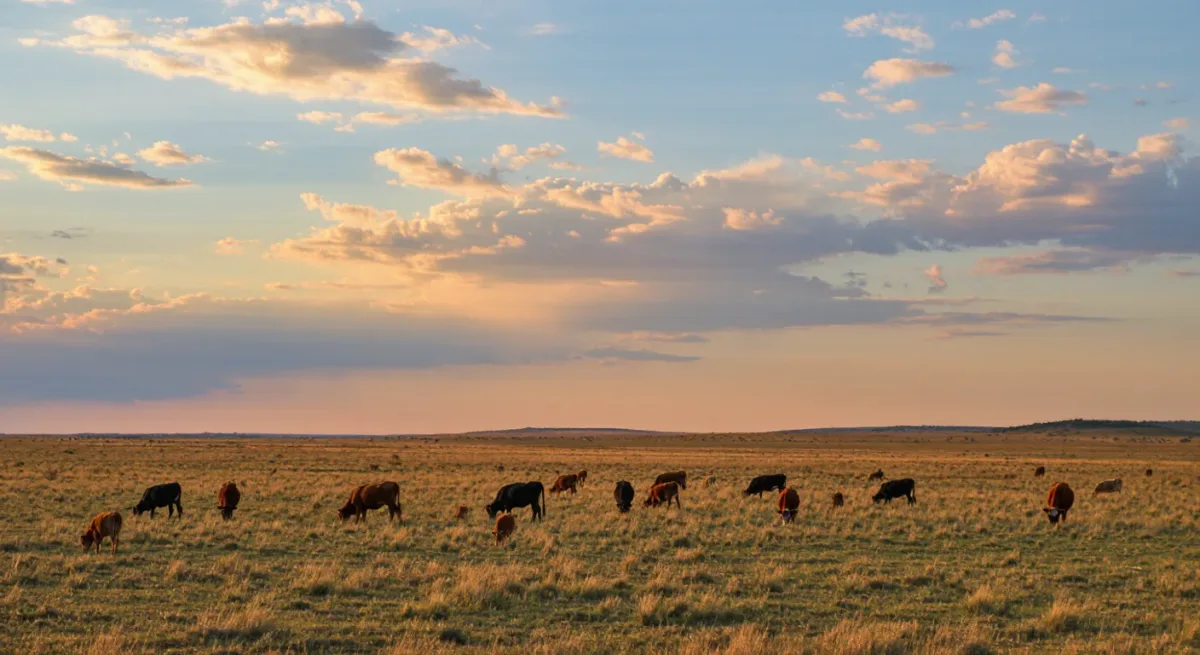
Argentine beef was built on a geographic accident: the humid pampas, a vast grassland where temperate climate and rainfall let cattle graize outdoors year-round with minimal inputs. From the saladeros of the nineteenth century through the frigoríficos that shipped chilled beef to Europe — at the time a feat of logistics that made Argentina one of the world's richest countries — the cattle economy scaled on grass. The modern industry still runs largely on pasture, finishing cattle on grain only in the last months for premium cuts, which shapes both the flavor profile the market prizes and the cost structure that limits volume growth.
Domestic appetite, export arithmetic
The domestic market eats most of what the country produces, which makes Argentines' own consumption the industry's central variable. When per-capita eating falls — as it did sharply during the 2023-2024 inflation spike, when beef was partly displaced by cheaper chicken — the entire chain feels it. Exports, the other leg, are dominated by a single customer: China takes roughly three-quarters of Argentine beef export volume by weight, buying mostly forequarter and offal cuts that command little premium at home. The more valuable cuts — the tenderloins and ribeyes of the northern hemisphere's steakhouse menus — flow in smaller volumes to the United States, Europe, Israel and Chile, markets where phytosanitary protocols and trade openings decide margins more than price (IPCVA; Senasa trade data).
| Indicator | Approximate level |
|---|---|
| Per-capita consumption | ~50 kg per year |
| National herd | ~50 million head |
| Top export destination by volume | China (~3/4 of export tonnage) |
| Grass vs. feedlot finishing | Predominantly pasture-based, grain finishing at the margin |
What the asado actually is, commercially
The asado is the industry's marketing department, price support and product-development lab at once. Because Argentine cooks buy whole cuts rarely seen on foreign shelves — vacío, matambre, entraña, chorizo de carne for the choripán — the local counter culture sustains a carcass utilization rate other beef systems envy. The Saturday gather also anchors a protein inflation index that politicians track with fear: beef prices are among the most politically sensitive numbers in the country, and governments of every stripe have at moments capped exports to protect the domestic table, a lever the industry factors into every investment decision.
The pressures on the model
Three forces press on the business. Feed economics: grain-finished cattle compete with export crops for acreage, and each hectare switched to soy is a slow vote on herd size. Finance: cattle are a store of value in Argentina, and when the peso wobbles, holding cows can beat holding deposits — good for the herd, distorting for the supply of beef to market. And climate: the pampas' rainfall is less dependable than a century of records suggests, with dry cycles forcing herd liquidations that echo through prices years later.
Why it still works
For all that, the system endures because its two pillars reinforce each other: a domestic eating culture that keeps utilization high and a land base that keeps costs low. The Argentine steak abroad — from Buenos Aires churrasquerías to the parrillas of Madrid and Miami — trades on that combination, and the country's cut names travel on menus without translation in a way few national food vocabularies manage. The asador lighting charcoal on Sunday afternoon is, in a precise economic sense, doing demand management for a fifty-million-head supply chain.
The export chain, from corral to container
Between the pasture and the Shanghai hotpot sits an industrial system most consumers never see. Cattle move from breeding herds through backgrounding and, for a growing share, feedlot finishing — grain-fed lots that Argentina expanded precisely to hit the marbling and weight specs export markets pay for. The frigoríficos — the packing plants clustered from Buenos Aires province up the Paraná — are the chain's capital-intensive core, and their economics swing with the spread between Argentine cattle prices and international beef quotations. When that spread opens, exports surge and domestic prices feel it within weeks, which is why the trade-opening decisions of recent years — Argentina fully liberalizing beef export flows in 2023 — were politically contested as kitchen-table policy, not agricultural administration.
Certification is the quieter barrier. Each destination requires state veterinary protocols — Senasa's negotiation history includes the halal certifications that opened much of the Chinese and Middle Eastern demand, plant-by-plant approvals that can take years, and traceability requirements that pushed the whole chain into individual animal identification. The industry's strategic anxiety is that its facilities are built for the cuts China wants, and its ambitions lie in the cuts Europe and the United States pay premiums for — a marketing problem wearing a veterinary certificate.
For another Argentine export built on patience and fire, read our feature on Mendoza's Malbec economy, and find more reporting in the Argentina section.