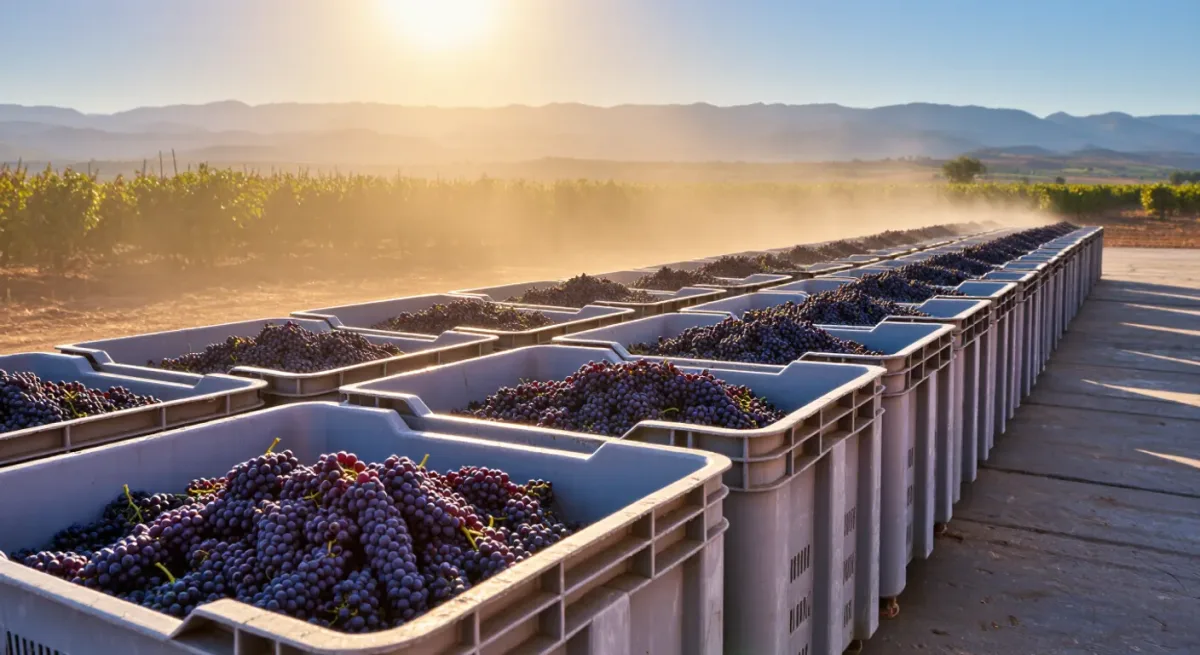
The harvest trucks start before dawn on the road from Tupungato, carrying bins of Malbec picked at 1,300 meters above sea level, and by noon the same grapes are being sorted inside wineries whose tasting rooms sell futures to visitors from the United States, Brazil and Britain. Mendoza province concentrates roughly 70 percent of Argentina's vineyard area and the overwhelming share of its wine exports, and Malbec — a French variety that nearly vanished from its homeland — is the label that carries the business (Instituto Nacional de Vitivinicultura).
A grape that emigrated
Malbec arrived in Mendoza in 1853, brought by the French agronomist Michel Pouget as part of the young national government's push to modernize provincial agriculture. In Cahors, in southwestern France, the variety had been a workhorse; in Mendoza's high, dry, sun-flooded valleys it found something better — a place where altitude thins the oxygen, thickens grape skins and concentrates color. Phylloxera and the 1956 frost later destroyed most of France's Malbec, while Argentina's plantings, grown on their own roots in sandy Andean soils, kept going. Today Argentina holds by far the world's largest Malbec vineyard area, on the order of 45,000 hectares, and the variety dominates the country's fine-wine export mix by value (INV).
Why altitude is the whole business model
Mendoza is not one terroir but a staircase. Vineyards climb from about 800 meters around the city of Mendoza to beyond 1,500 meters in the Uco Valley, in districts like Gualtallary that two decades ago were considered too cold to farm. Every hundred meters of altitude buys cooler nights, stronger ultraviolet light and a longer ripening curve — the combination that gives Argentine Malbec its signature combination of dark fruit and structured tannins, and gives wineries a ladder of price points from a single variety.
- Water: the vineyards are irrigated almost entirely with Andean snowmelt, delivered through canal systems laid out over more than a century, which makes vintage quality hostage to snowpack as much as sunshine.
- Wind: the Zonda, a hot dry Andean wind, can scorch flowering vines in a single afternoon, the region's most-feared weather event.
- Vintage timing: harvest runs roughly February through April, several months ahead of the northern hemisphere, which lets Argentine wineries sell into a different cash-flow calendar than their competitors.
The numbers that rule the sector
Argentina's wine economy is an export story with a shrinking domestic base. Per-capita wine drinking in Argentina has fallen for decades, from well over 70 liters a year in the 1970s to a fraction of that today, which forces bodegas to sell abroad to grow. The United States is the top market by value for bottled wine, followed by the United Kingdom and Brazil, and Malbec is the flagship variety across all of them (INV export statistics). The 2023 harvest, cut by spring frosts, hail and an El Niño year, came in as the smallest in more than two decades — a shock that emptied tanks, raised grape prices and reminded the industry how quickly biology can reprice a balance sheet.
| Indicator | Position of Malbec / Mendoza |
|---|---|
| Mendoza share of national vineyard area | ~70% |
| Malbec share of national fine-wine exports | Leading variety by value |
| Top export markets by value | United States, United Kingdom, Brazil |
| Altitude range of premier zones | ~900–1,600 m |
Wine tourism as the second crop
The tasting room has become as strategic as the tank farm. Mendoza's wine routes — Maipú and Luján de Cuyo near the city, the Uco Valley farther south — draw hundreds of thousands of visitors a year, and a bodega that converts a tourist into a home-country customer has effectively acquired a distribution channel for the price of a glass. Provincial authorities and wineries have invested accordingly, in bike routes, lodges and harvest-season programming around Vendimia, Mendoza's wine festival held every February and March since 1936.
The risks are as clear as the upsides. Climate volatility now moves harvest dates earlier year by year, water rights are a permanent political negotiation, and global wine consumption is softening at exactly the moment new plantings from the 2020s enter production. Mendoza's answer has been to climb — higher, more marginal, more distinctive vineyards — because altitude is the one input its competitors cannot copy.
The 1990s reset that made it possible
The modern industry was consciously designed. In the late 1980s, Argentine wine was a volume business — high-yielding vineyards, cheap table wine, a domestic market drinking itself smaller every year — and a generation of producers concluded the model was terminal. The decisive figure was Nicolás Catena, a third-generation Mendoza winemaker who spent time in California's Napa Valley and returned convinced that Mendoza's altitude could do for Malbec what Napa had done for Cabernet: convert a workhorse variety into a world-class one at a premium price. He planted high in the Uco Valley when local agronomists called it too cold, invested in small-capacity fermentation, and pushed Argentine wine into the international fine-wine conversation for the first time.
Foreign capital followed the proof. Chilean wineries crossed the Andes first; then European and American groups — Moët Hennessy with its sparkling-wine project in the Uco Valley among them — bought land, built showpiece bodegas and imported distribution networks. By the 2000s the formula was set: altitude Malbec, foreign investment, wine tourism infrastructure, and an export pitch — quality at prices Bordeaux could not match — that carried Argentina's wines onto lists from London to Tokyo. The domestic shrinkage that forced the pivot never reversed; the exports it forced created the industry that now sells Mendoza to the world, and the Catena gamble is taught in Mendoza's wine schools as the sector's founding decision.
For the story of another Argentine export built on terroir and patience, see our report on the country's beef and asado economy, or browse the wider Argentina section.