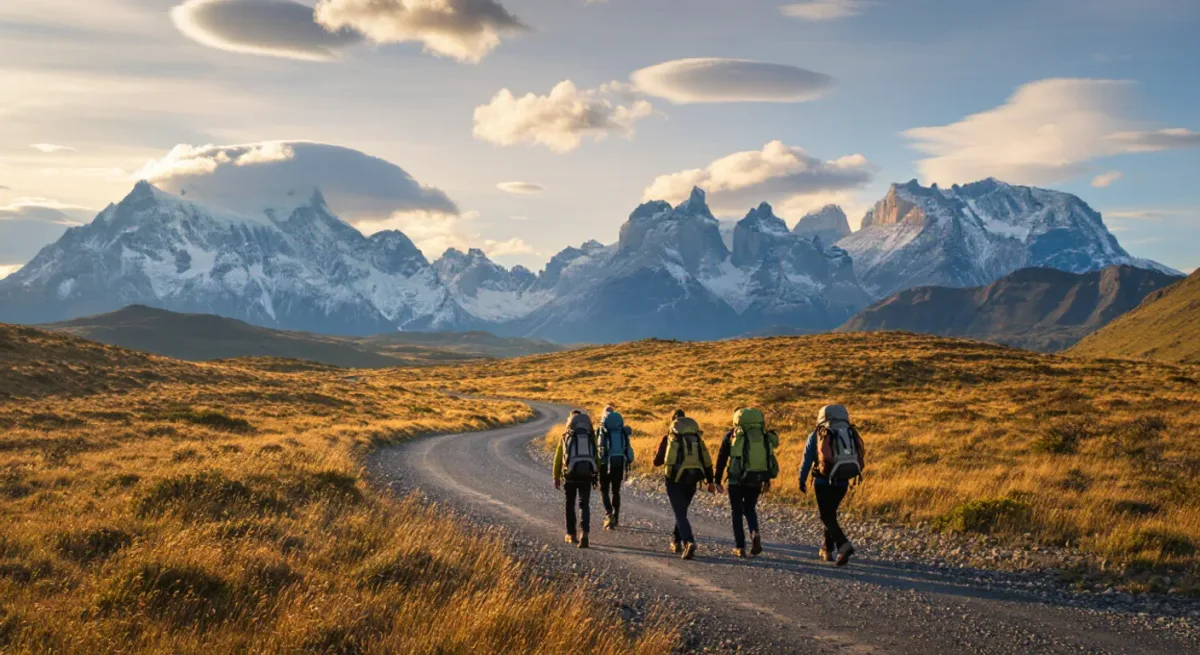
The ice wall of the Perito Moreno glacier stands about 70 meters above Lake Argentino, and every few minutes a slab the size of a bus calves off and drops into the water with a sound like artillery. The walkways facing it are among Argentina's most visited natural attractions, the anchor of a tourism economy that stretches 2,000 kilometers south from the wine country of northern Patagonia to Ushuaia, the city that markets itself — profitably — as the end of the world. Patagonia is the country's most seasonal, most dollar-dependent and fastest-growing tourism asset (Parques Nacionales; INDEC tourism statistics).
The three poles of the south
- El Calafate and the glaciers: gateway to Los Glaciares National Park, a UNESCO World Heritage site since 1981, with Perito Moreno as the star and the trekking hub of El Chaltén an hour and a half north.
- Península Valdés and the Atlantic coast: southern right whales arrive between June and December near Puerto Madryn and Puerto Pirámides — a whale-watching season the peninsula's protected status, also UNESCO-listed since 1999, turned into a global draw.
- Bariloche and the lake district: Argentina's oldest national park, Nahuel Huapi, created in 1934 from land donated by explorer Francisco Moreno, wraps a city that sells skiing in winter, trekking in summer and chocolate year-round.
The season is the business model
Everything in Patagonian tourism prices around the austral summer, December through February, when daylight stretches past ten in the evening and the hiking, glacier and wildlife circuits run at capacity. The whale coast inverts the calendar, peaking in the southern spring. Operators therefore build annual budgets on roughly ninety high-season days that must carry the winter shoulder — one reason hotel rates in Calafate in January rival European capitals, and one reason capacity, from flights to hotel rooms, is the sector's permanent constraint. Aerolíneas Argentinas and its low-cost competitors allocate aircraft to the south seasonally, and every added route visibly moves provincial employment.
What the weak peso did
The macro turmoil of the 2020s re-priced Argentine travel twice over. A competitive peso made Patagonia a bargain for foreign visitors — Chileans crossed the Andes to shop, Americans and Europeans discovered five-star lodges at emerging-market rates — while domestic travelers, priced out of imported alternatives, rediscovered their own south. Hotel-occupancy statistics in Santa Cruz and Tierra del Fuego showed some of the country's strongest gains through the 2024-2025 seasons (INDEC hotel survey). The inflow financed a construction wave of lodges and expanded national-park infrastructure, and it taught provincial treasuries that tourism is export income that arrives without shipping containers.
The pressures everyone in the industry names
Growth has a cost line. Perito Moreno's walkways and Los Glaciares' quotas are managed for conservation, and peak-season crowding at the marquee sites has pushed authorities toward timed entry and dispersed itineraries. The fly-in economy concentrates value in gateways — Calafate, Ushuaia, Bariloche — while park gateway towns debate how much of the visitor dollar leaks back to city-based operators. Climate volatility adds uncertainty to a product built on stable ice and reliable whale migrations; the scientific record shows Patagonia's glaciers retreating broadly, and Perito Moreno is the famous exception in rough equilibrium. And the whole model remains hostage to aviation economics: no reliable seasonal capacity, no growth.
| Circuit | Anchor attraction | Peak season |
|---|---|---|
| El Calafate / El Chaltén | Perito Moreno, Fitz Roy trekking | December–February |
| Península Valdés | Southern right whales | June–December |
| Bariloche lake district | Nahuel Huapi National Park | Summer and ski winter |
| Ushuaia | End-of-the-world branding, Tren del Fin del Mundo | November–March |
How to plan it
Book the marquee experiences — the glacier walkways, the whale departures, the Chaltén trails' refugios — months ahead for high season; the quotas are real. Keep distances honest: Patagonia is larger than most European countries, and 'nearby' on a map can be a full day of driving. Use Calafate-Ushuaia-Bariloche as air hubs rather than overland routes. And travel in shoulder months, October-November or March-April, when weather is variable, prices soften and the parks are quieter — the single best value decision in Argentine travel.
The winter nobody prices in
Patagonia's second season is invisible in most coverage but decisive in the region's annual accounts. From June, the lake district inverts into a ski economy — Cerro Catedral above Bariloche is the southern hemisphere's largest lift-served resort, serving a Brazilian market that treats Andean snow the way North Americans treat Caribbean beaches — while the whale coast's season builds toward spring. Winter does for Bariloche's hotels what January does for Calafate's: concentrates the year's cash flow into a few months, this time in a different currency's tourists. The chocolate-and-beer town built for summer hikers is, mid-July, a Portuguese-language ski town.
The counter-seasonal logic also explains Patagonia's infrastructure pattern: airports sized for two peaks, guides who migrate between activities rather than regions, and a hospitality workforce that follows the calendar north and south. Tourism authorities in Río Negro, Santa Cruz and Tierra del Fuego now market the two seasons as complementary products — trekking and glaciers in summer, snow and whales in winter — precisely because the shoulder months, when both products are closed, are when the industry's economics get thin and the region's employment counts its idle weeks. Any visitor planning a trip should mirror the logic: the best deals and the emptiest trailheads sit in exactly those shoulders.
For the northern bookend of Argentine terroir tourism, read our guide to Mendoza's Malbec country, and see the full Argentina section for more.