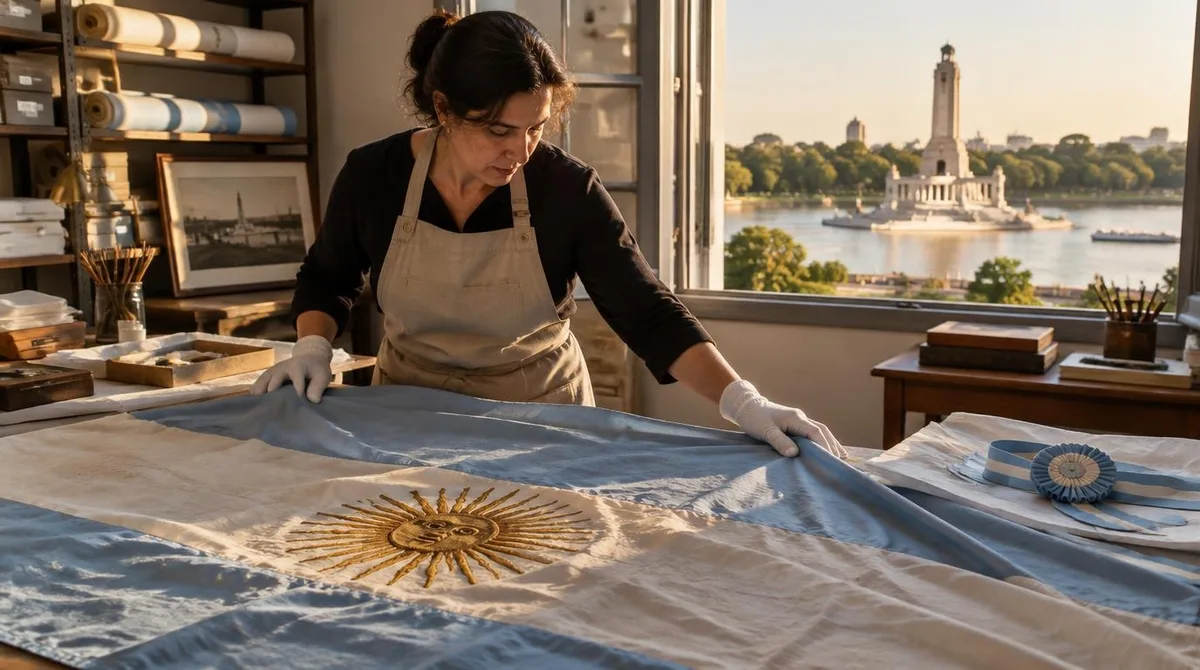
Argentina hoisted its flag for the first time on 27 February 1812, when Manuel Belgrano, guarding the Paraná River at Rosario, ordered a banner made in the colors of the national cockade. The cloth won legal status from the Congress of Tucumán in 1816, and a golden sun joined the middle stripe in 1818. Today the design counts among the most tightly specified national symbols in the region, fixed by law and decree down to the fabric.
The state keeps the rules public on its official symbols page. Argentina.gob.ar records what the law requires and who may fly the official flag. The short version: three horizontal stripes, light blue, white, light blue, with a gold sun of thirty-two rays at the center. Each part carries its own history, and each piece has a paper trail.
Why Light Blue and White?
The colors came from the cockade, not from a design brief. Casa Rosada, the presidential office, quotes Belgrano's own report: with no flag available, he ordered one made white and light blue, according to the colors of the national cockade. Belgrano was fortifying the river shores for the war of independence when he made that call. The cockade had been worn by patriots since the revolution of 1810, so the banner read instantly as a political statement. The Congress of Tucumán consecrated those same colors in July 1816, on the initiative of deputy Juan José Paso, per the state's symbols page.
What Does the Sun of May Stand For?
It is a reproduction of the sun engraved on Argentina's first coin, per the state's symbols page. The Congress of Tucumán's ratification in Buenos Aires on 25 February 1818 added the Inca sun to the central white stripe. Casa Rosada notes the geometry: the Sol de Mayo holds thirty-two rays, sixteen flamed rays turning clockwise and sixteen straight rays set between them. Until 1985 the sun belonged only to the war flag. Law 23.208 then unified the designs, so the flag now carries the sun at all times. The sun also anchors the flag in coinage, not in warfare.
Who Sets the Design Rules Today?
The national state does, through law and decree. Law 23.208 of 1985 governs use of the official flag, extending it to national and provincial governments, municipalities, official agencies, and to private citizens and civil institutions. The same law ended the split between the ceremonial banner and the war flag that had carried the sun alone. Decree 1650/2010, issued for the revolution's bicentennial, fixed the parameters for every official copy, from measurements to fabric and colors. The Argentina flag decree means a banner sewn in one province must match one raised in another, thread for thread. We covered a connected angle in What is the blue dollar, and why does Argentina have two exchange rates?.
How Does the Country Mark Flag Day?
On 20 June, the day Belgrano died in Buenos Aires in 1820, per the presidency's record. Law 12.361 of 1938 set the date, and Decree 1584/2010 made it an immovable holiday, per the symbols page. The daily ritual runs all year at the presidential palace. The Regiment of Mounted Grenadiers raises and lowers the flag on the Plaza de Mayo mast, at 07:15 and 19:00 in summer, at 07:30 and 18:00 in winter, with a detail of seven grenadiers on duty, per Casa Rosada.
Conclusion: What Keeps the Design Fixed
The next checkpoint is the calendar. Flag Day falls this year as it has since 1938, with school ceremonies and the Grenadiers' morning raising, and every official banner on display must match the 2010 decree. The unification of 1985 settled the last design dispute, and the state's symbols page now serves as the reference of record. What the region watches, in practice, is whether the standard holds at the margins, in municipal plazas and schoolyards, where the sun's rays and the fabric are the easiest corners to cut. Readers following this should also see The milonga economy: who pays for tango in Buenos Aires.