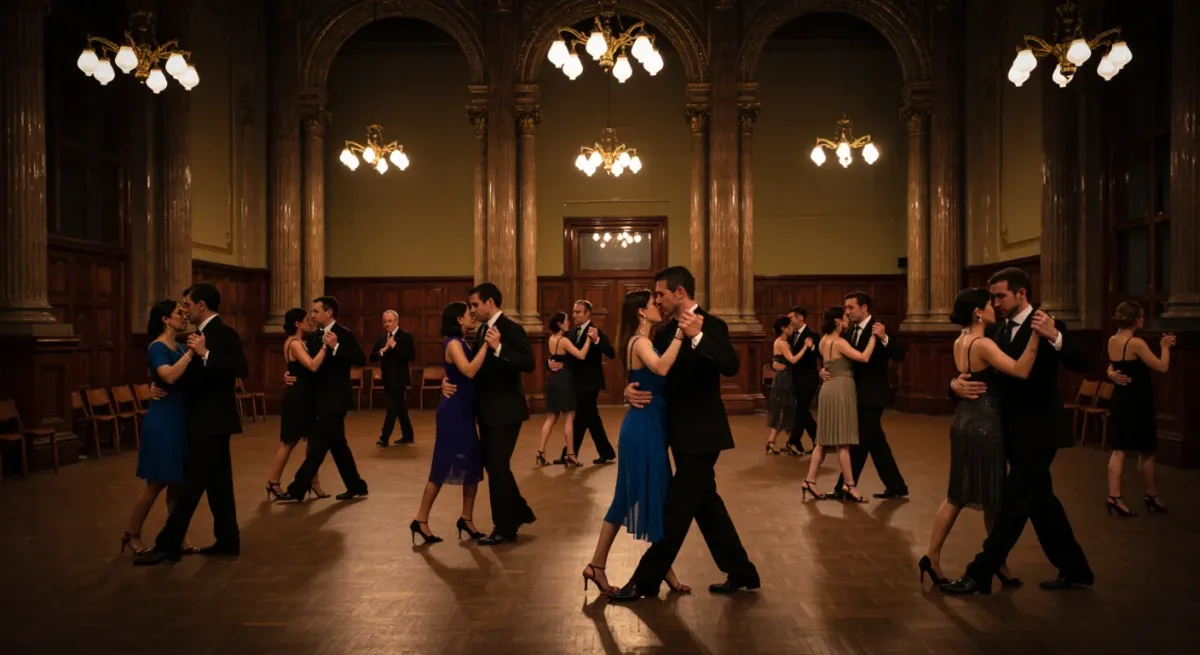
By nine in the evening, the floor of a San Telmo milonga has organized itself into lanes, older dancers in close embrace moving counterclockwise while a visiting Brazilian couple rehearse their steps at the edge of the parquet. Entry costs a few thousand pesos, a drink included; the DJ — a timeline of orchestras from the 1930s to the 1950s — is paid; the teachers who gave the introductory class at eight are paid. Nobody becomes wealthy, but the room is a small, functioning economy, one of several dozen that run nightly across Buenos Aires. Tango, declared part of humanity's intangible cultural heritage by UNESCO in 2009, earns its living one cover charge at a time.
From the arrabal to the world's stages
Tango assembled itself in the late nineteenth century among immigrants, freed slaves and dockworkers in Buenos Aires — and across the river in Montevideo, a parentage both cities claim. It traveled to Paris before World War I, returned home consecrated, and produced its two canonical commercial figures: Carlos Gardel, whose 1917 recording of 'Mi Noche Triste' founded the tango-song genre, and Astor Piazzolla, whose nuevo tango of the 1950s-70s forced the music into concert halls worldwide. That recording catalogue still earns, and Piazzolla's compositions remain the most licensed Argentine music in film and advertising.
Who makes a living from it
The tango labor market sorts into tiers with little mobility between them:
- Milonga circuit: organizers, DJs, class teachers — modest, cash-based, volume-driven, distributed across every barrio.
- Dinner-show industry: the theater restaurants of the tourist corridor employ stage couples, singers and orcheststras on formal contracts, running two seatings a night in high season.
- Festival professionals: couples on the international teaching circuit — Buenos Aires, Seoul, Istanbul, Bologna — for whom the city is headquarters and brand.
- Craft trades: shoe makers, costume ateliers, and the restorers of bandoneons, the German-built concertinas that define tango's sound.
The bandoneón bottleneck
The strangest monopoly in the business is historical. The great bandoneons were built in Germany by Alfred Arnold in the 1920s and 1930s; the factory closed after World War II and was never truly replaced. Working AA instruments now change hands among players at collector prices, restoration workshops in Buenos Aires keep hundred-year-old reeds playable, and new production from specialist makers runs to a handful of instruments a month at five-figure dollar prices. An entire genre's sound supply depends on a factory that has been dead for eight decades — and on the artisans who refuse to let the remaining stock die with it.
August is the industry's fiscal year
The Buenos Aires Tango Festival y Mundial, held annually since 1999 and staged every August, functions as the ecosystem's trade fair and world championship at once. Hundreds of thousands of attendees fill free concerts and competition rounds across the city, and the finals — salon and escenario categories — set the rankings that drive bookings for the following year's international tours. A couple that reaches a final can reprice its teaching calendar; a winner becomes a brand. The city government's culture machinery, which runs the festival, treats tango as tourism infrastructure with a measurable return, which is precisely how the dance survived the collapse of its mass domestic audience in the 1960s and found its present global one.
What the dance is worth
No single statistic captures the sector — it is distributed across tourism, teaching, performance and crafts — but its components are visible: a nightly milonga circuit, a dinner-show corridor priced in hard currency, an instrument trade with waiting lists, and an export business of traveling teachers and companies. Tango's economic lesson is unusual among cultural industries: it scaled without industrializing, preserved its amateur base as its professional pipeline, and monetized authenticity rather than replacing it. The embrace, it turns out, clears the market.
Teaching the world to embrace
The sector's largest quiet export is instruction. Buenos Aires is the world's tango conservatory: foreign students stay weeks or months, taking private classes in the afternoon and practicing at the milongas at night, and a teaching economy of couples and solo maestros has formed around them — Spanish-language lessons priced by the hour, accommodation arranged around the practice schedule, and a calendar organized by which milonga hosts the best practica on which night. The pedagogy is a genuine discipline, codified over decades: tango's improvised lead-and-follow system is taught with a technical vocabulary foreign students learn in week one, and the city's teacher-training courses professionalize what was once oral tradition.
The international circuit feeds back into the Buenos Aires market. A couple that teaches in Europe and Asia for three months returns with capital, reputation and a home-city audience; visiting students who fell in love at a San Telmo workshop open tango schools in Berlin, Seoul and Istanbul, importing Argentine teachers for annual festivals; and the dance's gravitational center — the place where credentials are earned — remains the city that invented it. Tango's economy, in that sense, works like a great university's: the world comes to study, and the alumni carry the brand abroad, ensuring the next cohort's flights are already booked.
The dance's demographics tell the market's future: Buenos Aires milongas skew older, while the international student body skews younger — the trade of a city exporting its heritage while importing its next generation of performers.
To see how another Buenos Aires cultural export turned global, read about the city's tech industry and Mercado Libre, or explore the Argentina section.