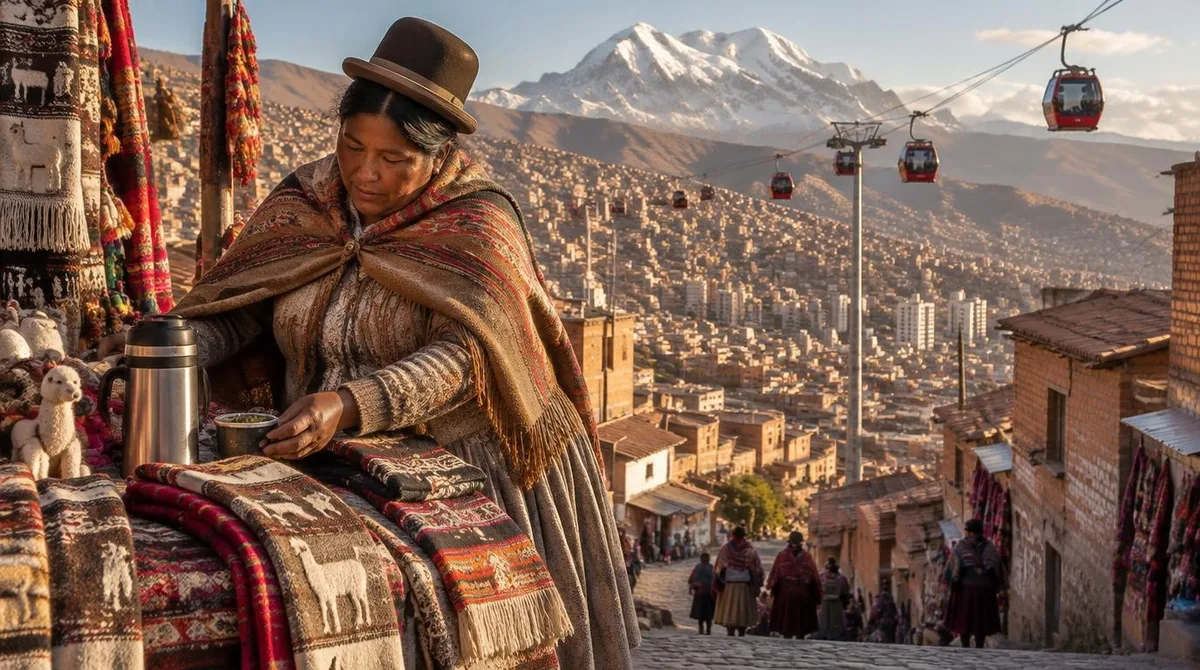
From the window seat on the La Paz descent, the Altiplano looks like a sheet of hammered copper. That plateau, and the chain that lifts it, is the spine of the Andes region: the longest continental mountain range in the world, running roughly 8,900 kilometres along the western edge of South America through seven countries, per Wikipedia's Andes entry. Argentina, Chile, Bolivia, Peru, Ecuador, Colombia and Venezuela all share it. That shared geography is the quiet fact behind most highland business in South America.
The range averages about 4,000 metres in height, which means many of the region's largest cities sit at altitudes where visitors reach for oxygen and locals reach for coca tea. Bogotá, Quito, La Paz, Santiago, Medellín, Arequipa and Sucre all sit on or near Andean plateaus and valleys. The terrain is not a backdrop to the economies here. It is the economy. We covered a connected angle in Small farms, global price: the 540,000 families behind Colombian coffee.
What exactly is the Andes region?
The Andes region is the highland corridor formed by the Andes mountain range, the world's longest continental range, spanning seven South American countries along the Pacific side of the continent. Geographers divide it into three broad sections: the Northern Andes in Colombia, Ecuador and Venezuela, the Central Andes in Peru and Bolivia, and the Southern Andes in Chile and Argentina. The range also splits by climate into the Tropical, Dry and Wet Andes, a division that explains why a single chain can hold cloud forest, desert and glacier.
The numbers are hard to picture until they are stacked. Aconcagua, on the Argentine side near Mendoza, rises to about 6,961 metres, the highest peak in the Western Hemisphere. Ojos del Salado, on the Chile–Argentina border, reaches roughly 6,893 metres and is considered the world's highest active volcano. Ecuador's Chimborazo holds a stranger record: because of the equatorial bulge, its summit is the point on the Earth's surface farthest from the planet's centre. The Altiplano, shared by Bolivia and Peru, is the world's second-highest plateau after Tibet's.
How did the mountains themselves form?
The Andes are the work of a collision still in progress. The oceanic Nazca Plate slides beneath the South American Plate, a process called subduction, and the crumpling and uplift of that meeting built the range over geological time, beginning in the Mesozoic era. The same forces place the chain squarely on the Pacific Ring of Fire, which is why earthquakes and volcanoes remain part of highland life. The Peru–Chile Trench marks the seam offshore.
That geology is not only scenery. It loaded the mountains with metal. Copper, gold, silver, iron ore and coal deposits run through the range, and Earth Eclipse's fact survey of the Andes notes that Chile and Peru together account for roughly half of the world's mined copper, and that Peru's Yanacocha ranks among the planet's largest gold mines. Mining is, for several of these governments, the fiscal foundation everything else rests on.
Which economies run on the range?
Each highland country monetizes the mountains differently, and the contrast is the region's business story in miniature.
- Chile and Peru lean on extraction. Copper dominates Chile's export ledger; Peru pairs its copper with gold and a fast-growing food-export sector built on the coast and valleys below the peaks.
- Bolivia balances two economies at once: the mineral wealth of the high plateau and the tourism draw of landscapes like the Salar de Uyuni, where salt-flat tourism and resource questions share the same horizon.
- Ecuador runs on the US dollar, a monetary experiment now in its third decade, which shapes how its Andean trade and tourism sectors price and plan.
- Colombia splits into three Andean cordilleras, and its coffee economy lives on their mid-slopes, where hundreds of thousands of smallholder families farm a crop that trades on a global price they do not set.
- Argentina uses its Andean west for mining, wine and mountain tourism, while the population and financial weight sit east of the range.
The pattern repeats: the peaks hold the minerals, the mid-slopes hold the crops, and the valleys hold the cities. Altitude is a business map.
What does tourism mean up there?
Tourism in the Andes region is altitude tourism, and it is serious business. Trekking, mountaineering, skiing near Santiago, stargazing in the Atacama and heritage travel around Cusco all sell the same raw asset: elevation. The practical questions visitors ask, about routes, seasons and acclimatization, are the same questions tour operators and regional governments budget around. The tension is familiar across the range: the sites that draw the crowds are also the sites most strained by them, as the management problems around Machu Picchu's ticketing have shown.
Culture travel carries much of the rest. Andean textiles remain a living craft and a commercial one, with weaving traditions that read as both art and economic record. Peru has turned its cuisine into a national export strategy, building Lima into a dining destination on purpose rather than by accident. In each case the product is the same thing the mountains gave the Incas: distinctiveness you cannot manufacture at sea level.
What did the Andes give the world's kitchens?
Two of the most widely eaten crops on Earth came from these slopes. The potato and the tomato both originated in the Andean region, and Peru alone is home to thousands of potato varieties; the count commonly cited runs to at least 3,800. Quinine, the malaria treatment, comes from the cinchona tree of the Andean forests. The highlands also domesticated the camelids, the llama, the alpaca and the vicuña, whose fibre still anchors a niche but valuable textile economy in Peru. Readers following this should also see Salar de Uyuni: the world's biggest mirror runs on two economies.
The biodiversity numbers are as striking as the agricultural ones. According to WorldAtlas's profile of the Andes Mountains, the region holds more than 30,000 vascular plant species, about half of them found nowhere else, along with roughly 1,700 bird species, over 1,000 amphibians, and some 600 each of mammals and reptiles. Two-thirds of the Andean amphibian species are endemic. For a region courting eco-tourism, that inventory is the product catalogue.
What this means for anyone doing business in the highlands
Our analysis of the range's economics comes down to three durable rules. First, logistics are altitude-shaped: what moves between Andean cities moves by air or by slow mountain road, and that cost is priced into everything. Second, the resource base is real but politically contested; mining and lithium governance in Chile and Bolivia are live policy questions, not settled ones. Third, the premium products of the region, fibre, coffee, food, wine, craft and experience tourism, all sell provenance. The mountain is the brand.
What remains unknown is the pace of change. Climate shifts are already moving snow lines and glacier extents across the range, and no source in the public record fixes what that will cost the ski towns, the glacier-fed valleys or the hydropower schemes below them. The chain has been rising for millions of years. The economies on top of it are adjusting on a much shorter clock.