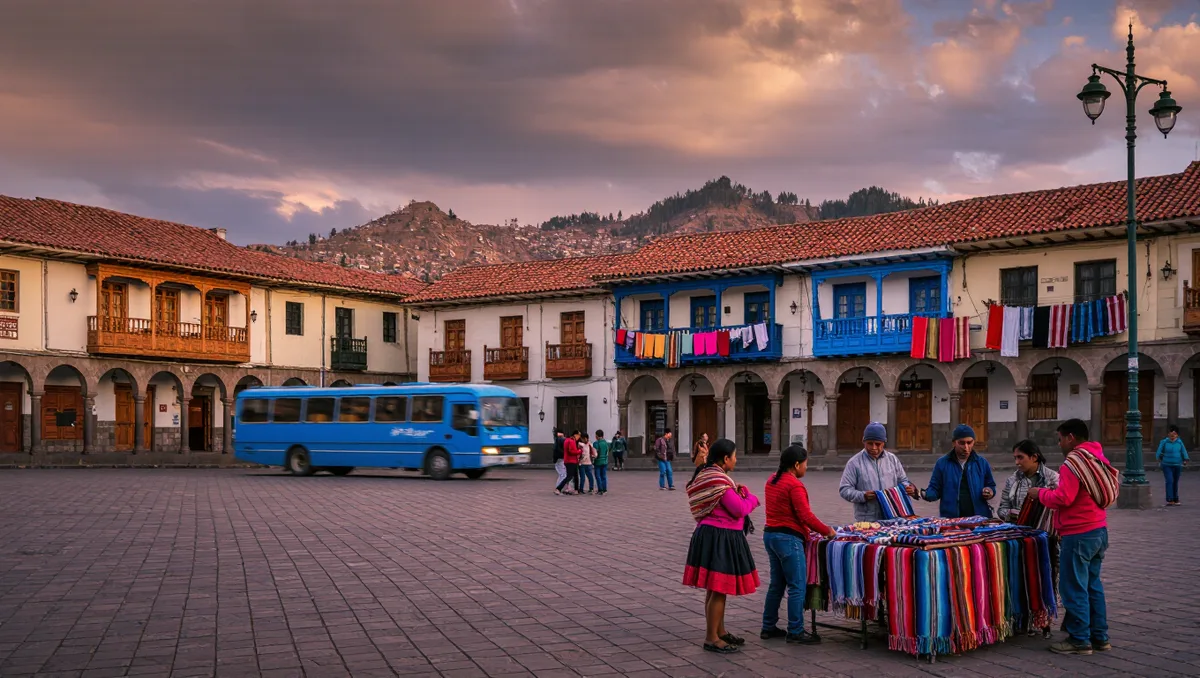
A woven belt from the Peruvian highlands does not announce itself. Its zigzags and stepped diamonds sit quietly in a market stall in Cusco or a shop window in La Paz. Yet those patterns are a language. In the Andes, cloth has long done the work that writing did elsewhere: it says who made it, where they belong, and what their community remembers.
That is the short answer to what Andean textiles reveal. They are a record of community, history, and identity, woven instead of written. The tradition runs deep. According to Wikipedia's overview of Andean civilizations, textile weaving stands among the defining achievements of societies that stretched some 4,000 kilometers down the mountain spine, from southern Colombia through Ecuador and Peru to northern Chile and northwest Argentina — cultures that built cities and empires without ever developing a written script.
For a visitor, learning to look at these textiles changes the region. A market becomes an archive. A woman's shawl becomes a biography. The pages that follow explain why cloth carried so much meaning, what the motifs can and cannot tell a reader, and where the tradition stands today.
Why did cloth carry so much weight in a world without writing?
Because it had to. Andean civilizations left no written language. Instead, they used the quipu, a system of knotted and colored cords, to convey information. Few quipus survive and scholars have not fully deciphered them; some argue they recorded only numbers, others that they could carry narrative as well. Textiles worked alongside such systems as a medium of memory in their own right.
The scale of the societies involved makes this clearer. Caral, on Peru's central coast, dates to around 3500 BCE and is the oldest known urban site in the Americas. Later came Paracas and Nazca on the southern coast, the Wari and Tiwanaku states, the Chimú kingdom, and finally the Inca Empire, founded at Cusco in 1438 as the largest empire the Americas had seen. Each of these societies wove. Cloth was labor, wealth, ritual object, and archive at once — a portable record in a world of high passes and long distances. We covered a connected angle in The world's best restaurant is in Lima. Peru built that on purpose..
Encyclopaedia Britannica notes in its entry on Andean peoples that the beauty of Andean textiles in museums worldwide is part of what complicates the region's stereotypes. That beauty was functional. A fine textile demonstrated a community's skill, its organization, and its ties to the herds and fields that produced the fiber.
What can a motif actually tell a reader?
More than a casual glance suggests, though less than a legend promises. Motifs in Andean weaving are often read as markers of place and belonging: a community's patterns can differ from the valley next door, and a garment's layout can signal a wearer's origin, status, or role. This reading rests on the region's social fabric as much as its cloth. Traditional Andean social organization centered on the ayllu, a kinship-based community whose land was held collectively and redistributed among family heads. Identity was communal and local, and cloth expressed it.
Some readings are widely repeated but hard to verify. A zigzag is often described as water or lightning; stepped figures as mountains; certain animal forms as protective or symbolic. These interpretations circulate among weavers, dealers, and scholars alike, and not all can be traced to a single authority. A careful reader holds them loosely. What the historical record supports more firmly is the pattern of continuity: the cultures that wove on Peru's southern desert coast, Paracas and its successor Nazca, left textiles whose color and complexity still anchor the region's reputation, and the habit of encoding meaning in cloth passed down through them to later societies.
There is also a caution worth stating plainly. Not every patterned textile sold to visitors carries an old community meaning. Some pieces are made for the market, in designs chosen because they sell. Reading a motif as history assumes the cloth has a history. The honest answer is that some do and some do not, and telling them apart takes time, sellers one can question, and a willingness to ask where a piece was made and by whom.
Who carries the tradition today?
The weavers themselves. Two indigenous groups remain central to Andean identity: the Quechua, whose language the Inca Empire spread across the region and who number in the millions across Peru, Bolivia, and Ecuador, and the Aymara, concentrated on the altiplano around Lake Titicaca, the high plateau that sits above 12,000 feet in Bolivia and Peru. Weaving remains part of daily life in many Quechua and Aymara communities, alongside the herding that supplies the fiber.
The fiber itself is part of the story. Andean peoples domesticated the alpaca and the llama, and that achievement, Britannica observes, helped make the mountains habitable to millions. The finest fiber of all came from the wild vicuña, whose wool was reserved for Inca royalty — an early sign that cloth in the Andes was ranked, regulated, and prized. The modern trade in that fiber is its own economy, one that Peru's fiber ladder traces from highland herds to global markets. For related coverage, see Four million alpacas, one soft economy: Peru's fiber ladder.
Tradition here is not frozen. Contemporary Andean designers and weavers adapt old techniques to new customers, and the pattern vocabulary keeps moving. What persists is the underlying idea: cloth is a statement of belonging, not just a product.
What this means for the traveler or collector
Look before buying, and ask questions before admiring. The most useful questions are the simplest: where was this woven, by whom, and on what kind of loom. Handloom work shows irregularities a machine does not produce. A seller who can name a community, a region, or a weaver is telling a verifiable story; a seller who cannot is offering decoration. Neither is worthless, but they are not the same thing, and the price should reflect which one it is.
It also helps to see the best examples first. Museums in Lima, Cusco, and beyond hold pre-Columbian textiles whose color and precision set the standard for everything made since. Seeing them first calibrates the eye. And because the tradition is living, the surest way to read it is to watch it being made — in a highland workshop, a cooperative, or a family loom — rather than to decode it from a souvenir rack.
Our analysis, for what the evidence is worth: the patterns reward patience more than expertise. A visitor who spends an hour comparing weavings from two different valleys will notice more than any guidebook can compress, because the differences are the point.
What the threads hold, and what they do not
Andean textiles reveal a civilization that archived itself in cloth. They show how communities organized themselves, how the ayllu and its kinship logic shaped what people wore, and how a tradition survived the Inca, the Spanish conquest of 1532, and five centuries of change. They also show the limits of reading: some meanings are documented, some are shared interpretation, and some are sales talk.
What remains unknown is substantial. The quipus have not been fully deciphered, so the full reach of Andean record-keeping is still open. And the specific meaning of many individual motifs rests on oral tradition rather than any surviving text, because no text exists. The cloth keeps its secrets generously — it shows a great deal, and it holds the rest.
What the region watches next is whether the living tradition keeps its economic footing: whether the communities that weave can also sell on fair terms, and whether the next generation keeps the looms working. The patterns will say. They always have.