Día de los Muertos, the Day of the Dead, is a Mexican tradition that welcomes the souls of departed loved ones back home for a visit each year, on the first two days of November. Families build altars called ofrendas, cook the dishes their relatives loved, and spend the night in cemeteries decorated with marigolds and candlelight. It is a memorial, not a mourning ritual: the tone is warm, even funny, because death is treated as part of life rather than an ending.
Visitors are welcome in many towns, and the holiday has become one of Mexico's most-attended travel seasons. That popularity carries a cost. In some places the celebration now doubles as a festival with tickets and stages, and the line between joining a family's remembrance and photographing it can get thin. Understanding what the altar means is the difference between the two. For the business side of that boom, see how cempasúchil season has turned the Day of the Dead into a serious industry. This connects to our earlier piece, Cempasúchil season: the Day of the Dead is now a serious industry.
This guide explains the traditions, the symbolism on the altar, and the etiquette that keeps a visit respectful. It also covers where the holiday is celebrated most strongly and what a first-time visitor should expect on the ground. The deeper context sits in our Mexico coverage, from food to festivals.
What is the Day of the Dead, and where does it come from?
The Day of the Dead is a two-day observance, November 1 and 2, that blends Indigenous Mexican beliefs about death with the Catholic calendar's feasts of All Saints' Day and All Souls' Day. The oldest roots are usually traced to pre-Hispanic cultures in central and southern Mexico, which kept skulls as reminders of mortality and saw death as a continuation rather than a conclusion. Spanish colonization moved the observance onto the Catholic feast days, and the modern holiday grew out of that combination.
The result is distinctive. Where much of the world marks the dead with solemnity, Mexican tradition leans the other way. Families speak to their dead, joke about them, and set a place for them at the table. The dead are guests, and the ofrenda is the welcome.
What goes on an ofrenda, and what does each element mean?
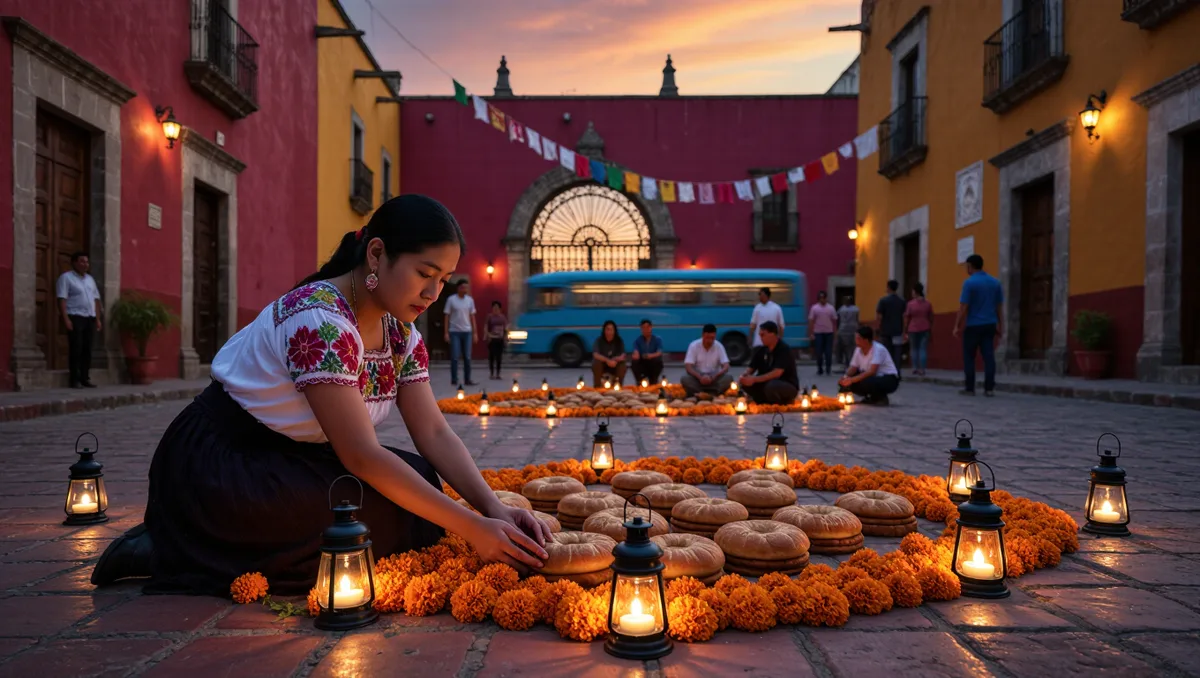
An ofrenda is a multi-level altar built at home, and every item on it has a job. The structure is simple once you know the logic: the altar is a map that guides the soul home and hosts it once it arrives.
- Photos and belongings. Portraits of the departed anchor the altar, often with personal items: a guitar, a sewing kit, a favorite cup.
- Cempasúchil, the marigold. The flower's strong scent and color are said to guide souls to the altar; petals are scattered in paths from the street to the door.
- Food and drink. Pan de muerto, a sweet bread topped with bone-shaped dough, appears alongside the dishes the person loved in life, plus water, salt, and sometimes mezcal or tequila.
- Candles and copal. Candles light the way; copal resin, burned since pre-Hispanic times, carries the scent that draws the souls in.
- Papel picado. The perforated paper banners represent wind and the fragility of life.
- Sugar skulls. Colorful calaveras, often with a name written on the forehead, treat death with affection rather than fear. Buying one with a living person's name is a running joke, not an insult.
Families often divide the two days: one for souls of children, who are remembered with toys and sweets, and one for adults, welcomed with the stronger flavors and the longer nights. For the regional flavors that show up on Oaxacan altars and tables, the Oaxaca in Seven Dishes: A Regional Food Primer is a useful companion.
Where is the Day of the Dead celebrated most strongly?
The holiday is celebrated across Mexico, but a handful of places are known for scale and spectacle. Mexico City has mounted a large central parade in recent years, drawing crowds and camera crews. Oaxaca de Juárez is famous for its comparsas, processions of costumed musicians and dancers that move through the streets at night. On the island of Janitzio in Michoacán, and across the Purepecha lake region, families hold candlelit vigils in cemeteries that last until dawn.
Smaller towns offer the most intimate versions. There, the cemetery vigil is a family event first and a visitor experience a distant second, and the difference is visible to anyone who walks through the gate.
How can a visitor take part respectfully?
The rule that covers almost everything: you are a guest at someone's memorial. Ask before photographing people, and always before photographing an altar or a grave. If a family invites you closer, follow their lead. If they do not, keep your distance and your voice low.
- Ask first, every time. A raised camera and a nod is usually enough; a refusal means stop.
- Buy from local makers. Cempasúchil bundles, pan de muerto, and sugar skulls sold in markets support the families who make the season.
- Do not treat face paint as a costume. Catrina makeup is common and mostly fine, but wearing it into a cemetery vigil reads very differently than wearing it at a street festival.
- Learn a few words. A greeting in Spanish, or in an Indigenous language where one is spoken, opens more doors than any lens.
- Spend the night if you are invited. The vigil, not the parade, is the heart of the holiday.
What this means in practice: the best visitor experiences come from towns that welcome outsiders without rebuilding themselves around them, and from travelers who arrive to participate rather than to document.
How has the holiday changed as it has grown?
Tourism has reshaped parts of the celebration. Larger cities now stage parades and ticketed events that sit alongside, and sometimes in front of, the family observances. Hotel prices rise sharply in Oaxaca and Michoacán in late October, and some cemeteries in famous towns now manage visitor flow. The James Bond film Spectre put a fictional Mexico City Day of the Dead parade on screens worldwide, and the real parade followed; the Pixar film Coco carried the ofrenda's meaning to a global audience of children.
The change is not all loss. The season sustains flower farmers, bakers, artisans, and entire town economies, and the films have made a generation of foreign visitors curious about a tradition they might otherwise never have met. The tension worth watching is whether the family altar keeps its primacy as the festival grows around it. Our analysis: the towns that manage that balance well are the ones where visitors are routed to public celebrations and the cemeteries stay, first of all, with the families.
What should you know before you go?
Plan early. Accommodation in the best-known towns fills months ahead, and transport on the holiday itself runs crowded. Pack for cool nights, especially at altitude in central Mexico. Bring cash for markets, where most of the season's commerce happens. And set expectations: the parade is the smallest part of the holiday. The ofrenda at a family's door, the petals on the sidewalk, and the candles in the cemetery are where the tradition actually lives.
Go as a learner, not a consumer of spectacle. The families who open their vigils to respectful visitors are offering a real welcome; the least a visitor can do is honor what the altar is for.
Sources: calendardate.com · nationaltoday.com · dictionary.cambridge.org · merriam-webster.com