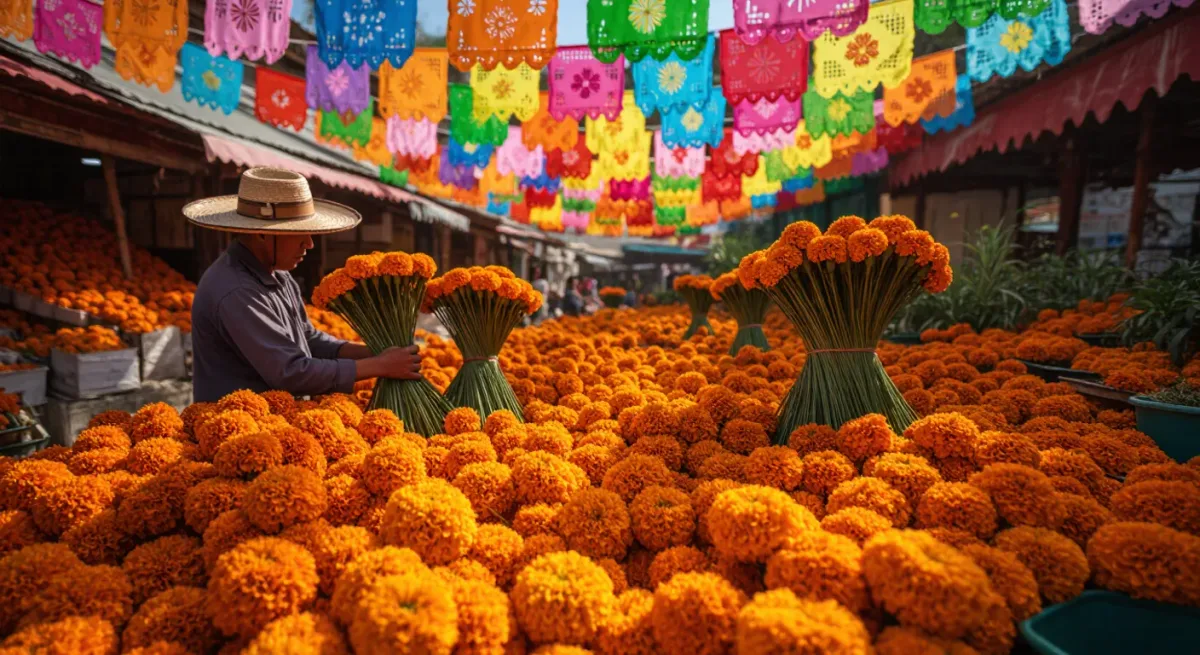
In late October, the flower markets of Mexico City fill with cempasúchil — the marigold whose orange defines the season — grown by families in Xochimilco and Tláhuac who plant in summer against a single fortnight of demand. By November 1, the ofrendas are built in homes, offices and public squares; the cemeteries of Oaxaca and Michoacán fill with families who keep vigil by candlelight; and the capital stages a parade that did not exist before 2016. The Day of the Dead is a religious observance, a UNESCO-listed cultural heritage, and — increasingly — an industry with a measurable calendar (UNESCO; city tourism records).
The heritage, briefly
The celebration fuses pre-Hispanic death rites with the Catholic All Saints and All Souls days: November 1 for children who died (Día de los Angelitos), November 2 for adults. The ofrenda — a tiered altar with photographs, food, water, salt, copal resin and the dead's favorite things — is the ritual's grammar, welcoming returning souls with scent, light and sustenance. UNESCO inscribed the indigenous festivity dedicated to the dead on its intangible heritage list in 2008, formalizing the recognition that lifted the date from family practice to national emblem.
How Bond created a parade
The Mexico City Day of the Dead parade is heritage's strangest provenance: its choreography descends from the opening sequence of the 2015 James Bond film 'Spectre,' whose fictional parade through the Zócalo was so convincing that the city staged a real one the following year — and has run it annually since, drawing hundreds of thousands of spectators and national broadcast coverage. The episode is a case study in culture economics: demand was manufactured by cinema, supply was invented by government, and the result now anchors a tourism season. Whether a four-century-old ritual 'should' have a parade remains a live debate in Mexico — a debate the parade's attendance figures have effectively settled (city government announcements).
Oaxaca's November premium
No market prices the date like Oaxaca. The city's hotels around November 1 sell out months — in the best properties, close to a year — in advance; comparsas (brass-and-fireworks processions) fill the evenings; the Xoxocotlán and Panteón General cemetery nights are the marquee photographs. The tourism compresses a year of income into weeks for guides, cooks, artisans and the alebrije and sand-tapete trades, and it has restructured the regional economy's expectations: November is to Oaxaca what Carnival is to Rio, an annual stress test of capacity that reliably overflows. Officials celebrate the receipts; residents negotiate the rents, and the quiet cemeteries that families once had to themselves now share space with camera crews (state tourism data; widely reported booking patterns).
- Floriculture: cempasúchil and terciopelo (cockscomb) are seasonal cash crops for the southern basin's growers.
- Crafts: papel picado, sugar and chocolate skulls, alebrijes, and pan de muerto bakers run seasonal production lines.
- Tourism: parade attendance, cemetery visits, festival packages; Oaxaca and Pátzcuaro are the flagship destinations.
- Exports of the form: Day of the Dead events now run in US, European and Asian cities — the diaspora and Pixar's 'Coco' did the marketing.
The commodification argument
The honest tension: a ritual whose meaning depends on intimacy has become a spectacle whose economics depend on scale. Anthropologists and Oaxacan residents worry about cemetery crowds and ritual performance; tourism ministries count arrivals; families, in the main, keep doing what they did — building the altar, cooking the mole, waiting at the grave. What the decade's evidence shows is that the date has absorbed global attention without collapsing: attendance abroad grows, and the domestic ofrenda persists as the load-bearing act. Cultural export on these terms is rare — usually the market flattens the rite; here the rite keeps outbilling the market.
Planning it
Book Oaxaca or Pátzcuaro lodgings by early in the year for the season; expect parade-week Mexico City hotel rates at peak; visit cemeteries early on the 1st or late on the 2nd, and ask before photographing vigils. The date moves nothing — November 1 and 2 are fixed — but the season now stretches across the last week of October, and the smart traveler treats the city's ofrenda exhibitions as seriously as the cemetery nights.
What the animated film exported
The date's global breakthrough had a distributor: Pixar's 'Coco' (2017), which packaged the ofrenda, the marigold path and the cemetery vigil into the most commercially successful film ever made about a national ritual. The measurable effects followed the standard blockbuster-geography curve: international interest in Day of the Dead tourism rose, foreign ofrenda-building spread from diplomatic cultural centers to school classrooms and brand activations, and Oaxaca and Mexico City's November seasons filled with visitors who arrived with the film's iconography pre-installed. Mexican tourism officials did not have to explain the holiday anymore; a Hollywood studio had spent nine figures doing it.
The film's production history added its own chapter to the culture-economics file: Disney's early attempt to trademark 'Día de los Muertos' — filed during development, withdrawn after public protest — became the canonical case study in cultural appropriation's legal frontier, and the studio's subsequent collaboration with Mexican consultants is now cited as the working template. The episode taught both sides the same lesson the parade learned a year earlier: global attention to the ritual is commercially enormous and politically conditional, and the custodians of the practice — families, communities, artisan guilds — hold a veto that functions through attention rather than law. The Day of the Dead's export economy runs on that negotiated consent, renegotiated with every adaptation, parade and pumpkin-orange corporate campaign each October.
For the other winged visitors who arrive each November and fill Mexican towns, read our feature on the monarch butterfly economy of Michoacán, and explore the Mexico section.