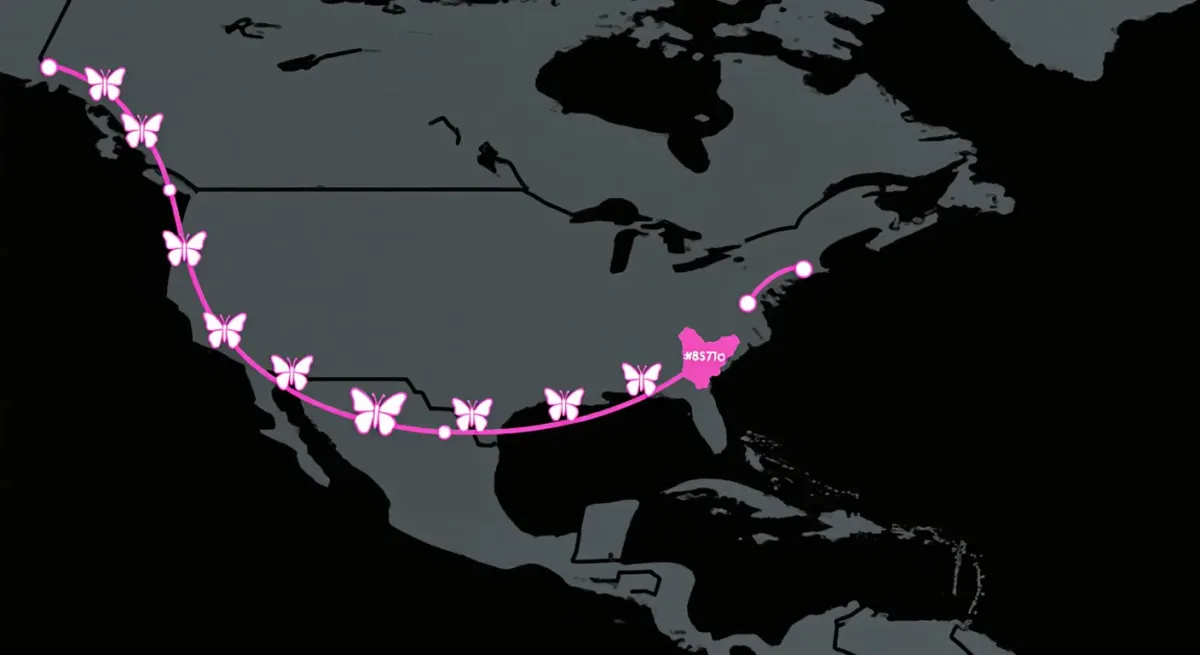
In the oyamel fir forests of Michoacán, the technicians of the Monarch Butterfly Biosphere Reserve walk transects in December and January counting not butterflies but area: the wintering colony is measured in hectares of forest canopy covered, because tens of millions of insects cannot be counted individually. The 2023-24 season measured 0.9 hectares — the second-lowest figure ever recorded — before a partial recovery the following winter. That single number, published each year by the WWF-Monarch Fund alliance with Mexican authorities, drives conservation funding, US Midwest agricultural politics and the tourism calendar of mountain towns whose economies the butterflies now anchor (WWF-Mexico and CONANP annual colony reports).
The migration itself
No individual monarch makes the round trip. The insects that arrive in Mexico each November are a third or fourth generation descended from butterflies that left the previous spring — an inherited itinerary spanning up to 4,000 kilometers from southern Canada across the American Midwest to the same dozen mountaintops their ancestors used. The reserve's high-altitude fir forests provide the microclimate they need: cool enough to slow metabolism and conserve the fat they will live on until March, humid enough to prevent dehydration, dense enough to buffer freezes. Logging thins the blanket; the colony's size each year is a verdict on conditions across the entire flyway — milkweed in the US breeding grounds, nectar on the migration corridor, weather at both ends.
| Season | Colony area |
|---|---|
| Recent decade range | ~0.9 to 6 hectares |
| 2023-24 | 0.9 ha — second-lowest on record |
| 2024-25 | Partial recovery from the low |
The conservation apparatus
The butterfly's winter home has been protected in stages: a 1980 presidential decree, the 1986 reserve, its expansion in 2000 to 56,000 hectares, and UNESCO World Heritage status in 2008. The hard economics are handled by the Monarch Fund, which pays ejido and community landowners an annual incentive per hectare of core forest they leave standing — an arrangement that converted the reserve's principal threat, illegal logging, into a managed decline, with near-zero deforestation in the core zone in most recent years. Storms still kill colonies by the millions — a March 2016 freeze event devastated that season — and climate volatility has replaced logging as the headline risk (CONANP; reserve monitoring).
The tourism economy
From November to March, visitors climb to the sanctuaries — El Rosario and Sierra Chincua above all — where local guides, many from the communities paid to protect the forest, lead the hour-long walks to colonies that hang like dead leaves until the sun warms them into flight. The season supports a modest but locally significant economy of guides, food stalls, lodging in Angangueo and Ocampo, and handicrafts, concentrated in a handful of weeks around the colonies' peak visibility. The arrangement is conservation's tidy loop: the forest pays its owners through tourism and incentives, and the owners keep the forest — a model studied wherever protected areas overlap with poor rural economies.
Why the numbers keep disappointing
The honest reading of the series is that Mexican winter protection succeeded at its half of the job while the flyway's other halves struggled. Herbicide-tolerant row cropping reduced milkweed across the US Corn Belt; intensified agriculture and drought degraded nectar corridors; temperature extremes disrupt the migration's timing. The US, Canada and Mexico signed a North American conservation plan, and volunteer efforts plant milkweed by the millions of stems — but the colony count, the metric that matters, has kept sliding toward the threshold below which scientists estimate an elevated extinction risk for the migration phenomenon. The butterflies vote with hectares, and the ballot is continental.
What to watch
The February announcement of each season's count has become the flyway's annual accounting. A strong season restores optimism and tourism; a weak one revives the debate over listing the monarch under the US Endangered Species Act, a decision with real consequences for American agriculture. What is not in dispute is the stake of the mountain communities: they hold the winter key to a phenomenon that belongs to three countries, and their incentives are the only part of the chain a single government can design.
The community payment math
The reserve's core zone overlays land owned by ejidos and Indigenous communities — the agrarian-reform property form that holds much of rural Mexico — which means conservation is negotiated with thousands of legal landowners, not imposed over them. The Monarch Fund's instrument pays per hectare of core forest left standing, with additional compensation for logging abstention; families receive the payment through their assemblies, and the amount is calibrated against what a landowner could earn from a tacit logging arrangement. The design's honesty is that it prices conservation against its alternative rather than against sentiment, and the results are measurable: large-scale illegal logging in the monarch reserve has fallen from a key threat to a marginal one across most of the core zone — a conservation outcome achieved, unusually, by treating the forest's owners as the forest's rangers.
Tourism distributes a parallel income stream. Sanctuary access fees, guide employment and the sale of food and crafts flow mainly to the communities whose land the butterflies land on, and the arrangement deliberately channels visitors through community-run cooperatives rather than external operators. The sums are modest against a national tourism economy, but they are decisive at the municipal scale — and they give the same families who might monetize timber a counter-incentive built on the butterflies' annual return. The model's quiet innovation is making the spectacular economically boring: a standing forest with a predictable annual dividend.
For the other seasonal arrival that fills Mexican towns each November, read our feature on the Day of the Dead economy in Oaxaca, and explore the Mexico section.