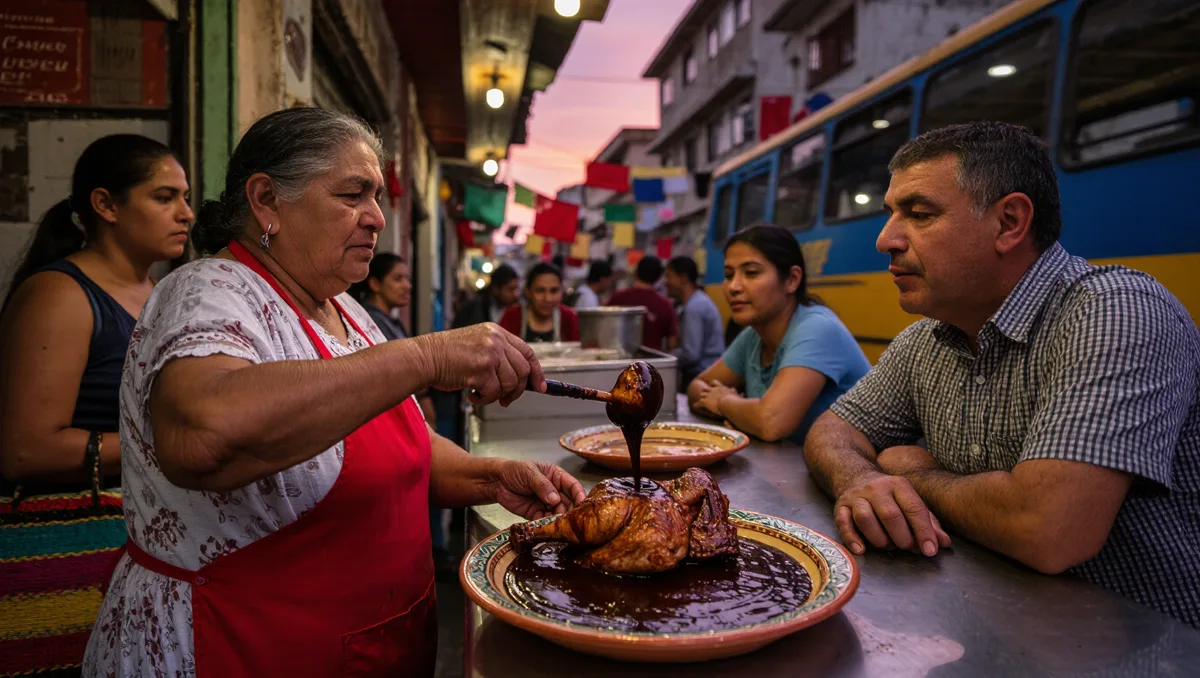
Oaxaca eats differently from the rest of Mexico, and the difference starts with corn. The state's food rests on the same base that fed the region before the Spanish arrived: corn, beans, chile peppers, squash, tomatoes and chocolate. Wikipedia's overview of Oaxaca notes that evidence of early maize domestication was found in the Guilá Naquitz cave near Mitla, a site UNESCO recognized in 2010 for holding some of the earliest known evidence of domesticated plants on the continent.
That deep history is one reason the state of roughly four million people, per the 2020 census figure carried in the same overview, cooks with so much variety. Sixteen Indigenous peoples are officially recognized there, led by the Zapotecs and the Mixtecs, and rugged terrain kept those communities and their kitchens distinct for centuries. Seven dishes below show what that isolation produced.
What is mole, and why does Oaxaca claim seven of them?
Mole is a family of sauces, not one recipe. A classic mole blends dried chiles with seeds, nuts, spices and often a little chocolate, cooked long and slow. Oaxaca is famous for its many versions, so many that locals speak of the "seven moles," a number that works more as shorthand than an exact count. Negro mole, the dark and sweet-spiced version, is the best known; coloradito, amarillo and verde each take a different path through the chile pantry.
What this means for a visitor: ordering "mole" in Oaxaca is the start of a conversation, not an order. The sauce takes a day or more to make in a home kitchen, which is why it marks weddings, birthdays and Day of the Dead gatherings. The state's food and its festivals are tightly linked, as the Cempasúchil season: the Day of the Dead is now a serious industry coverage shows. For related coverage, see Cempasúchil season: the Day of the Dead is now a serious industry.
Why is the tlayuda called Oaxacan pizza?
A tlayuda is a large, partly dried corn tortilla, toasted until crisp, then spread with asiento, the rendered pork fat paste, and black beans. Shredded cabbage, quesillo, tasajo and salsa go on top, and the whole thing is finished on a comal or over coals. The crisp base and open-face build earn the pizza comparison, though the flavor is entirely its own.
The tortilla's size is the tell. It can span wider than a dinner plate, and its half-dried texture holds toppings without going soggy. Street vendors in Oaxaca de Juárez sell them late into the night, and the dish has become the state's most exportable street food.
What makes quesillo different from other cheeses?
Quesillo, often called Oaxaca cheese abroad, is a stretched-curd cheese pulled into threads and wound into a ball. It melts into strings over tlayudas, memelas and enchiladas. The technique comes from cheesemaking traditions brought during the colonial period and adapted to local cow's milk in the Central Valleys.
Look for it sold in balls by the kilo in markets rather than pre-shredded. The hand-pulled texture is the point, and it does not survive industrial processing well.
How do memelas and tetelas fit the same corn tradition?
Memelas are thick corn masa boats, toasted on a comal, spread with asiento and beans, and topped with queso fresco and salsa. Tetelas fold masa into a triangular pocket around beans and cheese, a shape associated with the Mixtec areas of the state. Both are breakfast and market food, quick to cook and cheap to buy.
Both dishes also show the pre-Hispanic base in action. The state's diet before the conquest centered on corn, beans, chile and squash, a combination documented in the historical overview of the region, and these antojitos are that base with colonial additions like pork fat and fresh cheese layered on top.
What exactly is chapulines, and why do people eat grasshoppers?
Chapulines are toasted grasshoppers, tossed with garlic, lime and chile. They are sold in piles at markets like Mercado 20 de Noviembre and eaten as a snack, a taco filling or a garnish. The practice predates the Spanish; pre-conquest diets in the region included insects alongside hunted game such as turkey and deer, according to the historical record summarized in the state overview.
They are genuinely good: sour, salty, crunchy, with a chile burn at the end. Travelers should buy from busy vendors with high turnover, the same rule that applies anywhere street food is sold.
How does mezcal differ from tequila?
Mezcal is any distilled agave spirit, and tequila is one narrow type of it. Oaxaca is the heartland of artisanal mezcal, often made from espadín agave and sometimes from wild varieties, roasted in earthen pits, crushed and fermented in open vats before distillation. The smoky character comes from the pit roasting.
The economics matter here too. Agave takes years to mature, which makes both mezcal and tequila vulnerable to planting cycles and price swings. The seven-year hangover: agave economics and tequila's boom analysis covers how those cycles play out in Jalisco's industry, and Oaxacan mezcal makers ride similar pressures.
What is tejate, the drink that ties the table together?
Tejate is a pre-Hispanic drink of maize, cacao, mamey pit and cacao flower, whipped by hand into a cool, frothy brew. Women sell it in painted gourds at markets, especially in the Central Valleys around Oaxaca de Juárez and Tlacolula. It is one of the clearest surviving links between the region's ancient diet and its current one.
Our analysis of the seven dishes together: the throughline is corn handled with patience. Nixtamalization, the soaking of corn in alkaline water that unlocks its nutrients, underlies the tortillas, the masa for tetelas, and even the corn base of tejate. A visitor who understands that one process understands most of the state's cooking.
What should a first-time eater actually do?
Start at a market, not a restaurant. Mercado 20 de Noviembre and the Tlacolula Sunday market both offer several of these dishes in one walk. Order a tlayuda with quesillo, a memela, a small cup of tejate, and a taste of chapulines before committing to a full serving. Save mole for a sit-down meal, since it is the dish most worth someone's day of work.
Then widen the lens. Oaxaca is a small piece of a very large kitchen, and the Mexico section of this magazine tracks the country's food, economy and culture side by side. The Culture & Entertainment desk follows the region's wider creative life, from kitchens to concert halls. What remains unknown is how long the traditional supply chains behind these dishes, from milpa corn to wild agave, hold under tourism demand. That question, more than any single recipe, is the one Oaxaca's food economy now faces.