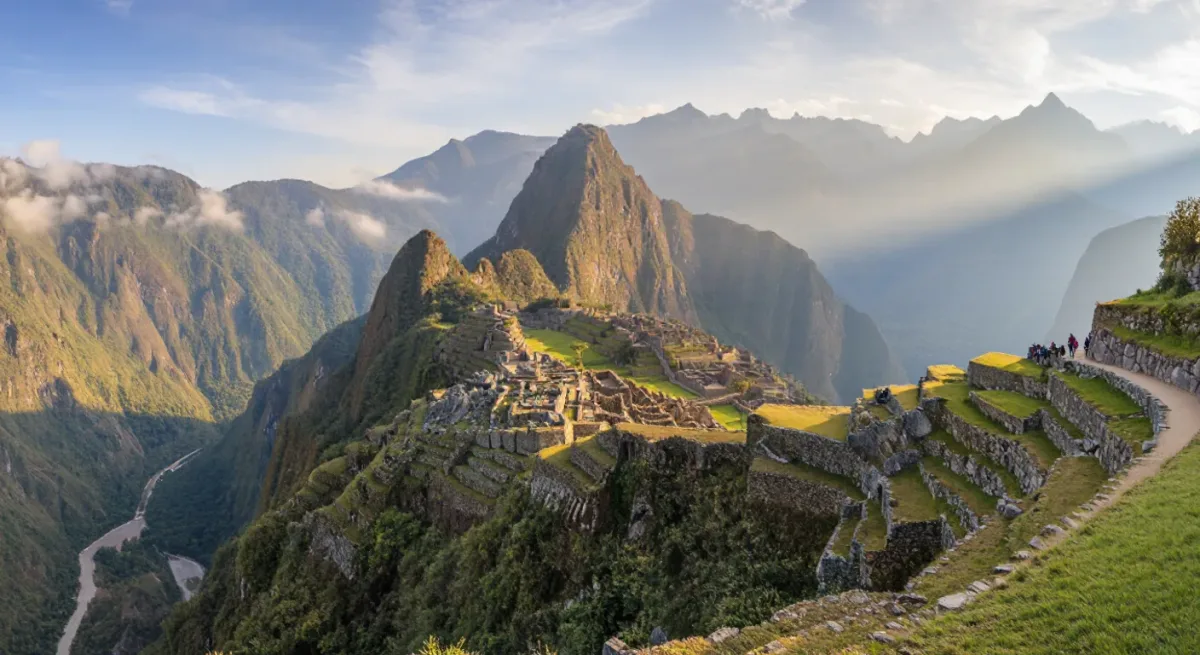
At 6 a.m. the first bus from Aguas Calientes switchbacks up the mountain, and by seven the postcard terraces have their first queue of the day — one of roughly 1.5 million annual visitors the citadel absorbs (Ministry of Culture of Peru). Machu Picchu was built in the fifteenth century as an Inca royal estate and abandoned within a century, never found by the Spanish, brought to world attention by Hiram Bingham in 1911, and declared a UNESCO World Heritage site in 1983. Its modern problem is the opposite of its ancient one: not abandonment but adoration, and the machinery Peru built to manage it is now the single most consequential part of any visit.
The quota system, in plain terms
Since the mid-2020s Peru has run the citadel on timed, capped entry with defined circuits: you buy a ticket for a specific route on a specific entry window, and you walk that route in one direction. Capacity has oscillated in the range of 4,500 to 5,600 people a day depending on season and policy adjustment, distributed across routes — the classic postcard circuit, the Inca Bridge route, and the options bundled with the sun-gate and mountain add-ons like Huayna Picchu. The logic is conservation arithmetic: soil compaction, terrace wear and slope stability degrade fastest where free-roaming crowds concentrate, so the state schedules the crowd instead of banning it (Ministry of Culture directives).
- Book ahead: tickets are sold through the official portal and authorized operators, and high-season dates sell out weeks out.
- Choose the circuit deliberately: the classic circuit delivers the postcard sequence; alternative routes trade the panorama for thinner crowds.
- Mind the gate time: arriving outside your entry window forfeits the slot; buses from Aguas Calientes queue from before dawn.
- Pack for rules, not just weather: no drones, no tripods in restricted zones, defined limits on bag sizes — enforced, not decorative.
Getting there: the three main doors
The classic Inca Trail is the four-day trek requiring a licensed operator and permits capped far below demand — book months ahead. The Sacred Valley train from Ollantaytambo to Aguas Calientes is the standard route, running several service tiers from backpacker to glass-domed. The budget overland route via Hydroeléctrica walks the final stretch along the rail line — cheaper, longer, unromantic, effective. All three converge on the same constrained assets: train capacity, hotel beds in a canyon town, and the bus fleet up the hill — which is why shoulder-season timing converts directly into money saved and solitude gained.
What the money does
Entry fees and the surrounding travel economy are a pillar of Peruvian tourism revenue and of Cusco's regional economy — guides, porters, cooks, hotels, artisans along every route. The Inca Trail porter economy in particular is a regulated labor market, with wage and load rules enforced after years of advocacy over working conditions. Conservation gets a defined share of gate revenue in principle; in practice, archaeologists debate how much of the fund reaches the site's stabilization needs, a tension between extraction and reinvestment familiar to every heritage destination on this scale.
| Visit element | Planning reality |
|---|---|
| Daily capacity | ~4,500–5,600 across circuits and seasons |
| Ticket model | Timed entry, fixed one-way circuits |
| Inca Trail permits | Capped; licensed operators only; book months ahead |
| Best-value window | Shoulder months: April–May, September–October |
The stewardship question
UNESCO has periodically flagged visitor pressure and landslides on the access slopes; Peru has responded with caps, circuits and re-routing rather than closures. The deeper issue is structural: a site whose carrying capacity is geological, a regional economy whose carrying strategy is the site, and a global bucket list that grows faster than either. Every visitor is now, in effect, a participant in that negotiation — which is why the honest guide begins not with the sun gate but with the ticket machine.
The Cusco dependency
Behind every Machu Picchu ticket stands a regional economy organized almost entirely around the citadel. Cusco's tourism sector — hotels, agencies, guides, restaurants, transport, artisan supply chains — exists at its current scale because roughly a million and a half visitors a year pass through the city en route to the site, and the practical mechanics of that passage concentrate value at chokepoints the visitor experiences as routine logistics. The train corridor from Ollantaytambo is served by two concessionaires whose fares set the trip's cost floor; the bus concession up the mountain is a monopoly priced accordingly; and the ticketing system's very complexity sustains an entire professional layer of agencies whose core service is navigating rules the state wrote. Each concession is a revenue stream the region and the national state negotiate over, periodically and publicly, because they are the industry's profit pools.
The fragility cuts both ways. Political protests that block the rail line or the road network — Peru's recurring social conflicts have several times emptied Machu Picchu on a week's notice — demonstrate how little slack exists in a regional economy running at capacity on a single asset; the covid closure year was a full-scale stress test the sector's businesses and workers absorbed with minimal buffers. Diversification is the official strategy — the Sacred Valley's lesser sites, the Inca sites beyond, the Manu rainforest circuit — but the map's physics are stubborn: the world queues for one ridge, and the region prices everything around the queue.
For another Andean exercise in managing what the world loves, read our feature on the alpaca textile economy, and see the full Andes section for more.