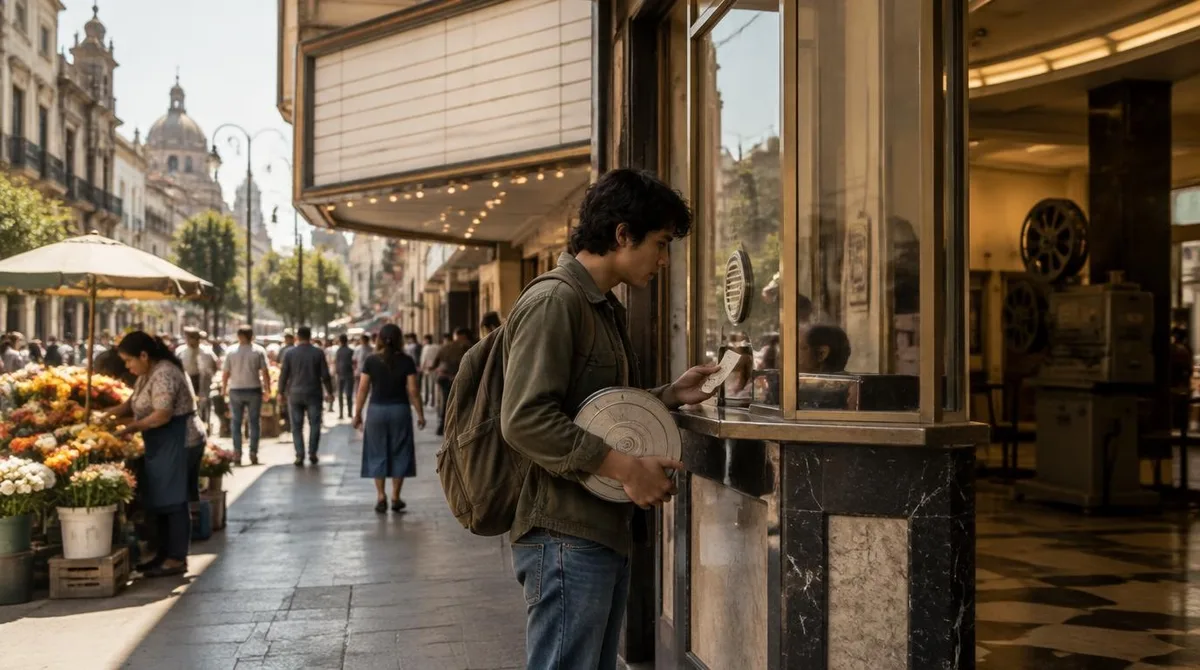
The fastest way into Latin American cinema is to pick a country and follow its sound. A film from Mexico City moves at a different rhythm than one from Buenos Aires or Rio de Janeiro, and the accent, the streets and the music tell you where you are before the plot does. This list of ten essential films is a starting point, not a ranking.
Each entry earns its place for a first-time viewer: it opens a door into a national style, a city, or a way of telling stories that repeats across the region. Watch them in any order. The point is range.
Why start with Mexico, Argentina and Brazil?
These three countries carry the largest film industries in the region, and their styles contrast in useful ways. Mexican cinema often works through intimate, city-bound drama. Argentine cinema leans literary, with long takes and moral puzzles. Brazilian cinema, especially out of Rio and São Paulo, brought the world a raw, street-level visual language that changed how filmmakers everywhere shoot urban poverty and violence.
They also speak two different languages. Hearing Spanish and Portuguese side by side trains your ear fast. Both are Romance languages that grew out of spoken, everyday Latin — what linguists call Vulgar Latin — which is why Spanish and Portuguese speakers can often follow each other across the border, as Simple English Wikipedia explains in its overview of how Latin evolved into the region's modern tongues.
The ten films, and what each one opens
Here is the shelf. Each line says what the film is and what it teaches a new viewer.
- Amores Perros (Mexico). A car crash in Mexico City ties three stories together. It is the clearest introduction to the fractured, high-energy urban style that ran through Mexican filmmaking at the turn of the century.
- Y Tu Mamá También (Mexico). Two teenagers and an older woman take a road trip to a fictional beach. The film's narrator keeps interrupting with what the camera cannot see, a device that says a lot about how Mexican cinema thinks about class.
- Roma (Mexico). A domestic worker in a Mexico City household, shot in careful black and white. Watch it for patience: the film asks you to look at labor and family the way you look at a painting.
- Central Station (Brazil). A retired schoolteacher writes letters for the illiterate at a Rio de Janeiro station, then takes a long journey north with a boy. It is a gentle entry into Brazilian filmmaking and the country's interior.
- City of God (Brazil). Gangs in a Rio housing project, told at a sprint. Its kinetic editing and handheld camera made it one of the most imitated films of its era, and it remains the reference point for Brazilian urban cinema abroad.
- Central do Brasil's companion in tone, O Auto da Compadecida aside, Elite Squad (Brazil). A police unit in Rio, told from inside the force. It pairs with City of God as the harder, more argumentative face of the same city.
- The Secret in Their Eyes (Argentina). A retired investigator reopens a murder case from decades earlier. Argentine cinema's taste for memory, justice and long, slow revelation is all here.
- Nine Queens (Argentina). Two con artists work a counterfeit stamp deal in Buenos Aires. A tight, funny caper that shows the country's gift for dialogue-driven plotting.
- The Headless Woman (Argentina). A woman hits something on a road and the film never fully resolves what. It is a study in guilt and perception, and a good test of whether the Argentine art-film register works for you.
- Also New Mexico's border stories, via Sin Nombre (Mexico/Honduras). Migrants ride the trains north through Mexico toward the United States border. It introduces the migration corridor that shapes so much storytelling across the region.
What this means in practice: start with City of God or Amores Perros if you want momentum, Central Station if you want warmth, The Secret in Their Eyes if you want a mystery that sits with you.
How do you watch them well?
Watch in the original language with subtitles. Dubbing flattens the performances, and half of what these films carry is in the voice: the Mexican Spanish of a Mexico City market, the porteño cadence of Buenos Aires, the Brazilian Portuguese of Rio's outskirts. Names carry their accents on screen and should in your notes too.
Give the slower films a full evening. Latin American cinema rewards attention over background viewing, and the region's best directors build meaning in long, quiet stretches between the dramatic beats.
Where does a new viewer go next?
Follow the festival path. Most of these directors reached international audiences through festival premieres, and the same route still carries new films from the region every year. The festival ladder explains how Latin American films reach the world, from a first screening to a streaming deal.
The current season is live too: Latin American titles are again on the Lido, with a Bechis competition entry and Gael García Bernal's debut carrying the region at Venice 2026. Watching the classics first makes those new premieres easier to place. We covered a connected angle in Venice 2026: a Bechis competition entry and Gael García Bernal's debut carry Latin America.
What does the region's film culture connect to?
Film sits inside a wider storytelling tradition. The literary boom that carried García Márquez and his contemporaries around the world shaped the region's screenwriting as much as its novels, a thread explored in After the Boom: who profits when Latin American literature travels. Domestic television matters too: the telenovela remains the region's most-watched narrative form, and its streaming afterlife shows how Globo-era storytelling survives the algorithm. Readers following this should also see After the Boom: who profits when Latin American literature travels.
For the wider frame — music, art, football and the business underneath — the magazine's Culture & Entertainment section gathers the coverage, and country desks such as Mexico, Brazil and Argentina follow each industry where it operates.
The takeaway for a first shelf
Ten films, three countries, two languages, and a spread of tones: the fractured city, the road movie, the domestic portrait, the caper, the memory piece. That range is the real lesson of Latin American cinema for a newcomer. The evidence here is durably qualitative — these are widely taught, widely circulated films — and what remains open is taste: which national register pulls you back for a second shelf.