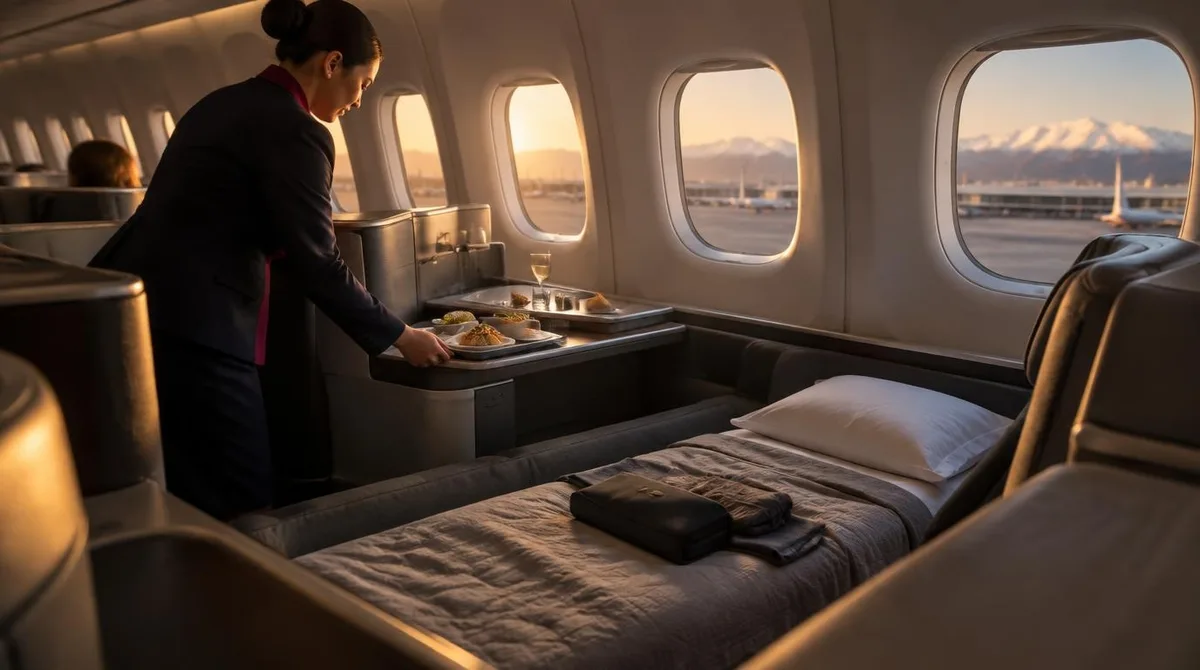
LATAM's Boeing 787-9 business class is a lie-flat cabin at the front of the aircraft, aimed at long-haul flyers between South America and North America, Europe, and Oceania. The short answer to what to expect: a fully flat bed, direct or near-direct aisle access, a multi-course meal service, and a quiet ride, because the 787's cabin is pressurized and filtered differently from older jets.
Whether that adds up to a worthwhile upgrade depends on the route. On overnight flights from Santiago or São Paulo to Madrid or Los Angeles, the flat bed does real work. On a two-hour hop within South America, the same cabin is a comfortable chair for a short ride, and the fare gap is harder to justify. A companion piece weighs that trade in detail: LatAm Business Class: Is It Worth the Upgrade?
This guide walks through the seat, the service, and the traveler each suits best. LATAM is worth a quick introduction first: it is the largest airline holding company in Latin America, headquartered in Santiago, Chile, with subsidiaries in Brazil, Colombia, Ecuador, Paraguay, and Peru, according to Wikipedia's overview of LATAM Airlines. The group flies a fleet of more than 300 aircraft, and the 787-9 is its long-haul workhorse.
What is the seat like?
The business cabin on the 787-9 is configured for flat-bed seating, with each seat converting into a bed roughly the length of an average adult. Newer layouts give every passenger direct access to the aisle; older configurations seat pairs side by side in the center section, which means climbing over a neighbor on some rows. Check the seat map for your specific flight before you pick, because LATAM has flown more than one business layout on this aircraft type.
The 787 itself does a share of the work. Boeing designed the airplane with a lower cabin altitude, larger windows, and smoother air filtration than earlier widebodies. Passengers routinely report arriving less worn out. That is a property of the aircraft, not the airline, but it is part of what the ticket buys.
Storage is the usual compromise. The seat offers a small compartment for a phone, headphones, and a water bottle, but a laptop bag generally goes overhead or at your feet during takeoff and landing. Window seats on direct-aisle layouts are the pick for solo travelers; couples tend to prefer the center pair.
How does the service flow work?
On long-haul departures, the flow is familiar. Boarding comes with a welcome drink and an amenity kit. Shortly after cruise altitude, the cabin crew serve a plated first course, a main, and a dessert, with a wine list that leans toward South American labels, a nod to the group's Chilean roots. After the meal service, the cabin dims, and most passengers convert their seats to beds for the middle of the flight.
A second, lighter service runs before landing. Between the two meals, the galley stays open for snacks and drinks, and crew respond to the call button. On daytime flights, the meal service compresses and the bed matters less.
Service quality varies by crew and by subsidiary, as it does on any multi-country carrier. The group's scale works in the passenger's favor on frequencies: the airline's consolidation across the region is covered in Six groups, one region: how Latin American airlines consolidated. Readers following this should also see Six groups, one region: how Latin American airlines consolidated.
Who is this cabin for?
Three types of traveler get the most from it. The first is the overnight long-haul passenger: a flat bed on a ten-hour flight from São Paulo to Europe is the difference between working the next day and losing it. The second is the traveler whose company books premium cabins on cross-border business routes, where arriving rested carries a real cost. The third is the points redeemer, since LATAM and its onetime alliance partners have historically made premium-cabin redemptions to and from South America attainable relative to U.S. carriers.
Two groups should think twice. Short-haul regional flyers pay a large premium for a bed they will never use. And travelers sensitive to cabin layout should verify the aircraft and seat map first, because an older center-seat configuration changes the experience noticeably.
How does it compare with the region's other premium cabins?
LATAM's 787-9 business class competes chiefly with Avianca and Copa in the region, and each takes a different approach. Copa flies narrow-body aircraft on many routes, so its premium product is a recliner seat rather than a flat bed; Avianca's widebody product has historically been more modest than LATAM's. For a route-by-route comparison, see Best Latin American Airline — Avianca, Copa, and LATAM: Choosing Your Latin American Airline. This connects to our earlier piece, Best Latin American Airline — Avianca, Copa, and LATAM: Choosing Your Latin American Airline.
The honest framing: within Latin America, LATAM's 787-9 business cabin is the region's strongest flat-bed product on the routes where it flies. Against North American or European carriers on the same long-haul routes, it holds its own on the seat and the sleep, and the gap, where one exists, shows up in lounge quality and ground service rather than in the cabin itself.
What should you check before booking?
Four things, in order. First, confirm the aircraft is actually a 787-9 on your date; equipment swaps happen. Second, open the seat map and look for the layout: direct aisle access or a center pair. Third, price the difference between business and economy against the flight's length; the upgrade math is covered in the worth-the-upgrade analysis. Fourth, if you are redeeming points, compare the award price against the cash fare, because the value of a redemption swings widely by date.
One caution on expectations: LATAM's own history shapes what you find onboard. The group emerged from Chapter 11 bankruptcy proceedings in 2022 after filing in 2020 during the pandemic, and its stock relisted on the New York Stock Exchange in 2024, per the Wikipedia summary of the company's financial history. Product investment has continued, but cabin refreshes roll through the fleet gradually, which is why two 787-9s in the same fleet can feel different.
Our analysis: where the cabin earns its keep
The evidence points one way. The 787-9 business cabin is at its best as a sleep product on overnight flights longer than about eight hours, and at its weakest as an upsell on daytime flights under four. Book it for the bed and the arrival, not for the meal or the status signal. Travelers flying within South America are better served by a good economy seat and the fare difference in their pocket.
What the available sources do not establish is per-route seat-map detail or current award pricing, both of which change. Verify both on LATAM's own booking page before paying. What remains clear is the structural point: the region's largest airline group has put its best product on its longest routes, and that is exactly where a buyer should evaluate it.