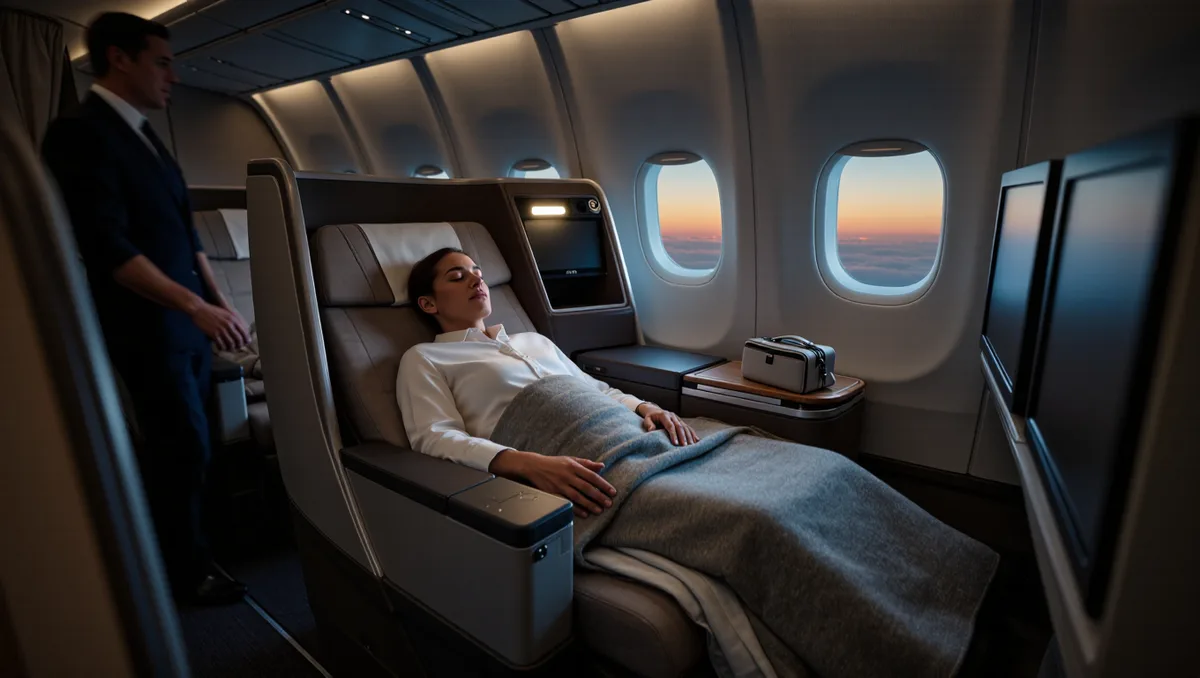
Business class on a South American route is worth the upgrade for one kind of traveller more than any other: the person landing with a full day of work ahead. A ten-hour overnight flight from São Paulo or Santiago to Europe or the United States, spent flat in a bed-width seat rather than upright in economy, changes what the next morning looks like. For a holiday where the first day is a beach day, the same fare is much harder to justify.
The honest answer sits in the middle. On the region's long-haul routes — the Brazil–Europe corridor, the Santiago–Los Angeles run, the Mexico–United States corridor — the premium cabin buys sleep, flexibility and a calmer arrival. On short hops within the region, it buys almost none of that, and the price gap rarely closes. This piece breaks down what the money buys, when it pays off, and where miles change the math.
What does business class actually buy on a South American route?
Three things, and they matter in that order. The first is the seat itself. On long-haul international routes out of São Paulo, Buenos Aires, Lima, Bogotá and Santiago, the region's major carriers sell lie-flat seating: a seat that converts into a fully flat surface, wide enough to sleep on your side. On a night departure that lands at dawn in Madrid or Miami, that is the difference between arriving rested and arriving wrecked.
The second is the schedule around the flight. A business fare typically includes lounge access, priority boarding, a checked-bag allowance above economy, and a ticket that is cheaper to change when a meeting moves. For a traveller whose plans shift with a board calendar, that flexibility is worth real money — often more than the meal service.
The third is the arrival. Business cabins deplane first, and on many South American airports the fast-track immigration line comes with the boarding pass. Landing at 6 a.m. in Lima with a 9 a.m. meeting is a different proposition when the queue is short. Readers following this should also see Which Latin American countries have trade deals — and with whom?.
When is the upgrade worth it — and when is it not?
Worth it: overnight long-haul flights where you must work the next day. This is the clearest case. A red-eye from São Paulo to Europe or from Santiago across the Pacific, flown flat, protects the day that follows. Travellers who sleep poorly upright get the most out of it; the seat is doing the work a hotel room would otherwise have to do.
Worth it: trips where plans move. South American business travel is volatile — a mine visit slips, a signing date moves, a strike changes the week. A flexible business fare absorbs that reshuffling; a discounted economy ticket often charges for it. This connects to our earlier piece, Avianca, Copa, and LATAM: Choosing Your Latin American Airline.
Not worth it: daytime flights and short regional hops. A four-hour flight from Bogotá to São Paulo, or a two-hour hop from Buenos Aires to Santiago, offers a wider seat and a meal but no flat surface and no sleep to protect. The fare premium on those routes buys comfort, not function.
Not worth it: holidays with an easy first day. If the plan is to check in, swim and sleep late, the arrival matters less. This is where the upgrade most often fails its cost-benefit test.
How do miles change the calculation?
They change it substantially, because the region's biggest carrier runs its own loyalty economy. LATAM's frequent-flyer program, LATAM Pass, lets members accumulate miles and redeem them for airline tickets and other products, and registration is free — LATAM Pass describes the program that way on its own site. For a traveller who flies the São Paulo–Santiago or Lima–Bogotá circuits regularly, redeemed upgrades and award tickets are the cheapest route into the front cabin.
The practical pattern is well known among regional road warriors: earn miles on the short hops you would take anyway, and spend them on the long-haul overnight where the flat seat matters most. That sequencing turns a premium cabin that rarely clears a cash cost-benefit test into one that does. The trade-off is availability — award seats in business class on popular long-haul dates go early, so flexibility in travel dates matters as much as the mile balance itself.
What this means for the business traveller
Our analysis: treat business class as a productivity purchase, not a comfort one, and price it that way. The question is not "is the seat nice" but "what is a lost working day worth". For an executive flying Santiago to Madrid overnight before a negotiation, a rested arrival can carry more value than the fare difference destroys. For a founder flying Bogotá to Mexico City for a single afternoon meeting, it almost never does.
Three practical steps follow from that framing.
- Match the cabin to the clock. Spend up on overnight long-haul flights; stay in economy on daytime and regional sectors. The same trip can mix both.
- Price the flexibility, not just the seat. Compare change fees and fare rules across cabins before comparing seat quality. On volatile itineraries, the flexible fare is a large part of what you are buying.
- Route the miles deliberately. If you fly one carrier's network repeatedly, its loyalty program is the cheapest path to the front cabin — but book award seats early, because premium-cabin availability thins fast on peak dates.
One more consideration belongs in the ledger: company policy. Many firms treat long-haul business class as approvable above a flight-duration threshold and economy below it. If you travel under such a policy, the cost-benefit question has partly been answered for you — the remaining decision is which flights to push against the threshold.
The bottom line for South American routes
The region's premium cabins earn their fare on exactly one flight type: the long overnight haul where sleep protects the next day's work. Everywhere else, the upgrade is a comfort purchase, and comfort purchases should lose to cash more often than they do. Travellers who fly the region's business circuits regularly can bend the math further through loyalty programs, letting miles — not the travel budget — carry them into the flat seat. The evidence here is qualitative, and the right answer varies with the itinerary; but the test itself is simple. If the flight ends at a desk, upgrade. If it ends at a pool, think twice.