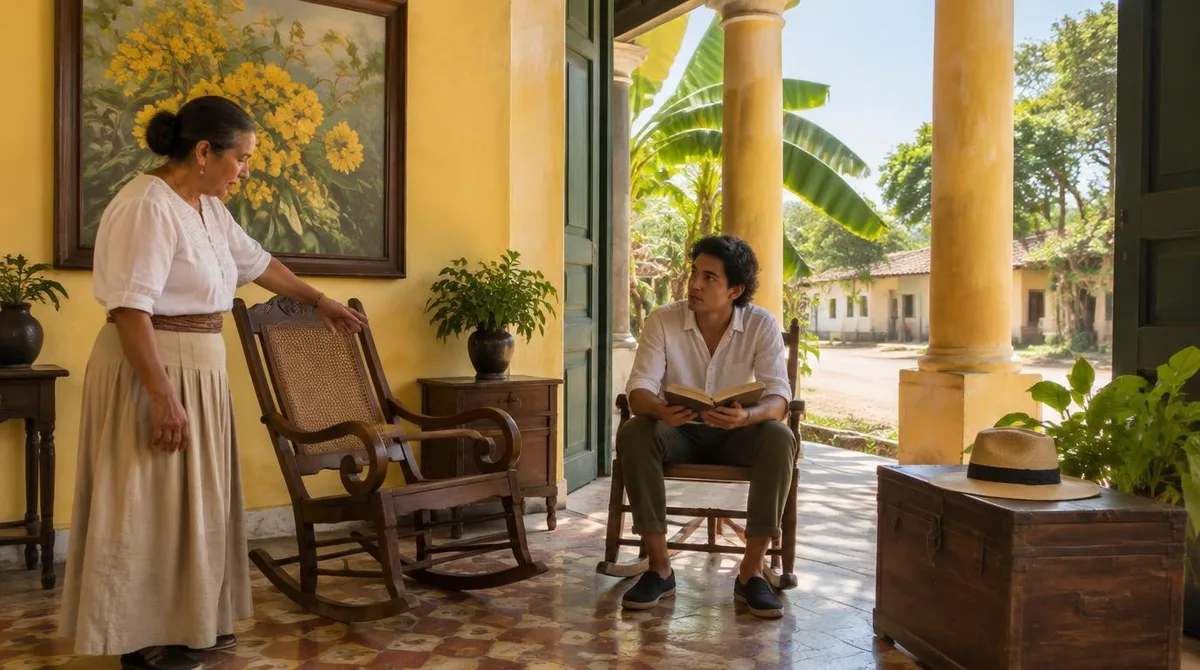
Colombia's most translated novelist grew up far from any literary circle. Gabriel García Márquez was born in 1927 in Aracataca, a small town in the country's tropical north between the mountains and the Caribbean Sea, per his Nobel Foundation biography. He was raised by his grandparents, and his grandfather was a pensioned colonel from the civil war of the early century.
That childhood keeps getting new audiences. On Aug. 26, 2026, Netflix premiered the grand finale of One Hundred Years of Solitude, a sixteen-episode adaptation of the 1967 novel that has sold more than 50 million copies, per the streamer's Tudum site. Any gabriel garcia marquez biography runs into the same puzzle: how the grandson of a provincial colonel built a fictional town the whole world could recognize on sight.
Where Did Gabriel García Márquez Grow Up?
He grew up in his grandparents' house in Aracataca, in the Caribbean region of northern Colombia. His parents had moved to the port city of Barranquilla, so the house set his whole world. The Nobel Foundation's biography places the town in a tropical region between the mountains and the sea, and it records that his grandfather had fought in the civil war at the beginning of the century. The boy went to a Jesuit college and began to read law. The studies did not last, and the newsroom did.
How Did He Become a Writer?
He came to fiction through journalism, after his law studies were broken off for newspaper work. In 1954 his paper sent him to Rome on assignment, and he mostly lived abroad from then on, in Paris, New York, Barcelona and Mexico, per the Nobel biography. His first novel, La hojarasca, appeared in Bogotá in 1955, and No One Writes to the Colonel followed in 1961, according to the foundation's bibliography of his work. Alongside the fiction, the biography notes, he kept filing journalism and wrote screenplays for the screen industry. This connects to our earlier piece, After the Boom: who profits when Latin American literature travels.
What Made One Hundred Years of Solitude a Global Event?
The novel came out in 1967 through Editorial Sudamericana in Buenos Aires, per the Nobel bibliography. Its story follows cousins José Arcadio Buendía and Úrsula Iguarán, who marry against their families' wishes and found the town of Macondo; several generations of the Buendía line follow. Per Tudum's tally from May 2026, the book has sold more than 50 million copies and has been translated into more than 40 languages. In 1982 the Swedish academy gave García Márquez the Nobel Prize in Literature, and the boy from Aracataca became Colombia's first laureate of letters. Readers following this should also see Venice 2026: a Bechis competition entry and Gael García Bernal's debut carry Latin America.
How Did Macondo Finally Reach the Screen?
As a full-scale Colombian production, filmed in Spanish, with the author's family behind it. Per Tudum, the adaptation runs sixteen episodes in two parts of eight, and it was shot in García Márquez's native Colombia. The first part earned acclaim, and the second arrived in August 2026: seven episodes on Aug. 5, split between directors Laura Mora and Carlos Moreno, then the grand finale on Aug. 26, directed by Mora alone. The author did not live to see it. He died of pneumonia at 87 on April 17, 2014, in Mexico City, per Wikipedia's sourced entry.
Conclusion: What Colombia Watches After the Finale
The close of the Netflix run ends the largest screen project in the novel's history, and it lands with the book still above 50 million copies on Tudum's count. The next chapter is quieter and just as Colombian: readers keep arriving at Macondo through a door that Aracataca opened in 1967, and classrooms keep assigning a novel that outlived its author by more than a decade. The country's writers now carry the question the finale hands back, which is which town, and which family, earns the next sixteen episodes.