Cumbia was born on Colombia's Caribbean coast, and few rhythms have traveled farther from their birthplace. The reach is measurable. Spotify reported in March 2024 that 84 percent of Colombian artists' streams come from listeners outside the country, led by Mexico, the United States and Spain. Much of that catalog moves on one drum pattern.
The stake goes past playlist counts. Cumbia music is the closest thing Latin America has to a shared popular language. Each country that adopted it rewrote the grammar, from the street parties of Monterrey to the barrios of Buenos Aires. One Colombian beat, endlessly localized, is the whole story. This connects to our earlier piece, Venice 2026: a Bechis competition entry and Gael García Bernal's debut carry Latin America.
Where Did Cumbia Actually Begin?
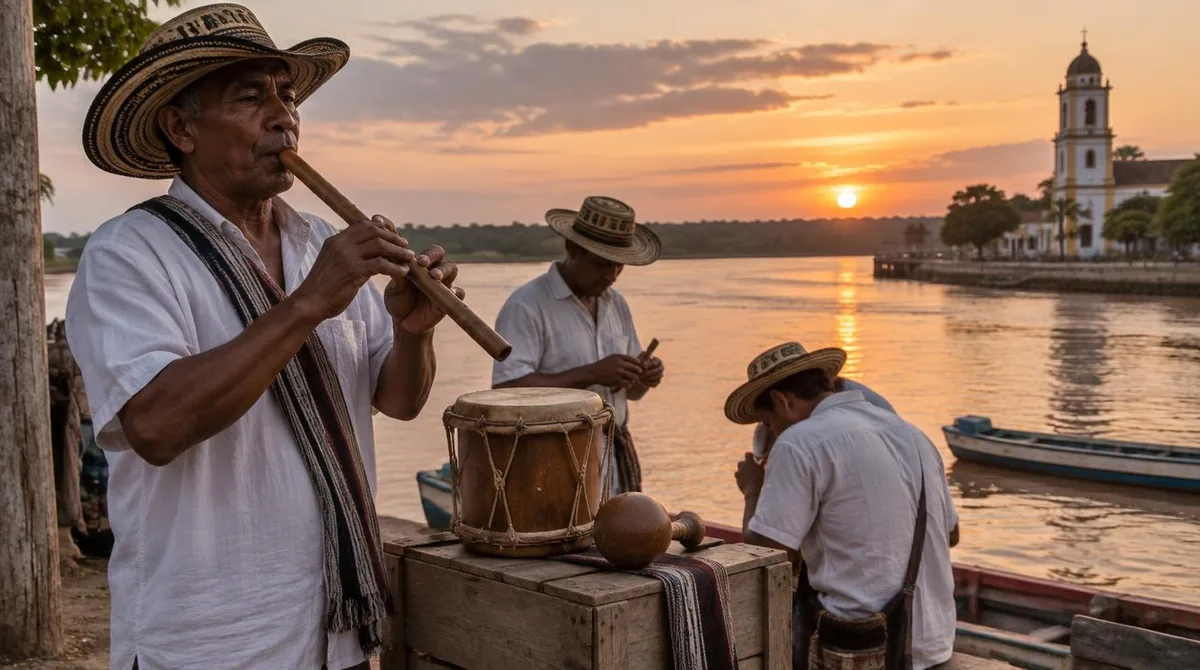
The most widely accepted account starts in the so-called Momposina region, near the delta of the Magdalena River in the Colombian Caribbean. Early cumbia joined Indigenous, African and Spanish traditions in one ensemble. So says the Los Angeles Philharmonic's genre history, published in August 2024. In the 1930s the music ran on a few traditional drums, a large single maraca and two gaitas. Those wooden flutes measure about a yard long. That style is still played and recorded by Los Gaiteros de San Jacinto, per the same account. The big-band format that bandleader Bermúdez built in the 1940s then carried the sound into Colombia's radio age. For related coverage, see The festival ladder: how Latin American films reach the world.
How Did One Rhythm Reach Mexico and Peru?
The travel agent was vinyl. In the 1960s, Mexican DJs flew to Colombia and hauled records home. That trade, per the LA Phil, helped start the sonidero street-DJ culture in Mexico City and Monterrey. Monterrey's sound systems slowed the records on playback and named the result cumbia rebajada. The city still treats the style as its own. Peru joined during the same decade. Colombian bands such as Los Corraleros de Majagual and La Sonora Dinamita supplied hits that Mexican radio played, and accordionist Aniceto Molina later moved to Mexico to spread the pattern further.
What Did Each Country Change?
Everything, and deliberately. Medellín bands such as Los Golden Boys and Los Hispanos recut cumbia in the 1950s and 1960s. Big-band arrangements were their formula. Mexican groups copied it almost immediately. Its influence spread to Mexico too. Bands such as Rigo Tovar y su Costa Azul built their own take on it, per the LA Phil. Argentina grew two branches of its own. The romantic orchestras of Santa Fe, led by Los Palmeras, filled one. Cumbia villera filled the other. It was born in the working-class barrios of Buenos Aires and popularized by Pablo Lescano. The Colombian drum pattern stayed at the core of all of it.
Why Does Colombia Still Claim the Rhythm?
Because the country keeps investing in the claim. The Festival Nacional de la Cumbia José Barros plays in El Banco, Magdalena. Law 1701 of 2013 declared it Patrimonio Cultural Inmaterial de la Nación, per the Colombian cultural platform CoCrea. The same listing confirms a 42nd edition for 2026. The festival is named for José Barros Palomino. It promises four days of traditional competitions, creative labs and the Cumbia Latin Sound space for new fusions, staged in the river town where the festival began.
Conclusion: Where the Beat Goes Next
The next checkpoint is that festival in El Banco. Its 42nd edition will test whether the folkloric root and the experimental branches can share one stage. The commercial signal already favors spread. With 84 percent of Colombian artists' streams now arriving from abroad, per Spotify's March 2024 report, that audience is no longer local. Whatever plays in El Banco can travel the same way. The rhythm that left the Magdalena delta on vinyl keeps finding new speakers, one country at a time.
For a style more than eight decades old, per the LA Phil's account, that is less an ending than a scheduled event.