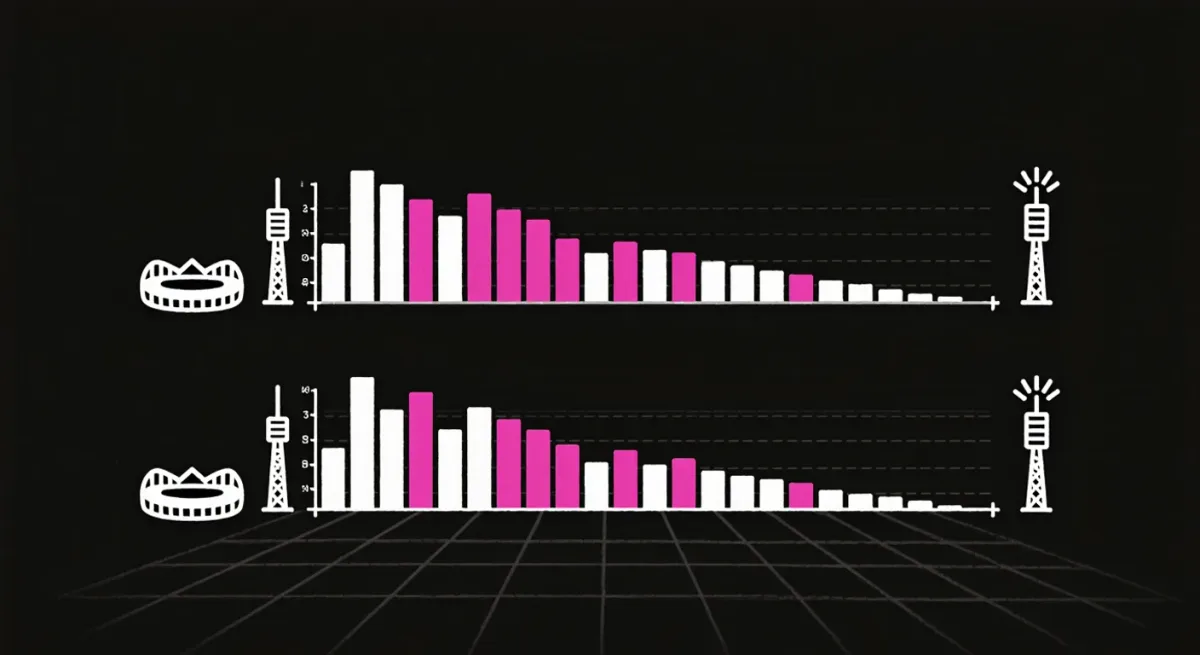
Liga MX, Mexico's first division, averages around 25,000 fans per match — attendance that ranks among the world's top leagues and regularly beats Major League Soccer's average — and it achieves this with almost no exports: the league's product is domestic stars, closed competition and a century of tribal loyalty. MLS, averaging in the low twenties of thousands, buys its relevance differently: global signings, a league-wide streaming deal with Apple worth a reported 2.5 billion dollars over ten years, and a growth narrative aimed at the world's biggest sports market. Two leagues, one increasingly shared North American soccer economy, playbooks pointing in opposite directions (league attendance statistics; Apple/MLS announcement).
Liga MX: the incumbent's machine
Liga MX's model is cohesion economics. With 18 clubs, two short tournaments a year (Apertura and Clausura) and no promotion or relegation since 2020 — a freeze introduced to stabilize club finances and made effectively permanent — the league maximizes scarcity and competitive randomness: more clubs genuinely compete for titles, fan attention never cools, and broadcast inventory stays valuable. The owners' group negotiates media rights collectively, and the league's Spanish-language broadcasts in the United States routinely out-rate English-language soccer — Liga MX is the most-watched soccer league on US Spanish-language television, a media position MLS spent a decade trying to approach. The cost of the closed model is sporting: without relegation pressure, squad investment is optimized for tournaments, not depth (league and broadcast records).
- Average attendance: Liga MX ~25,000+ per match; MLS low-to-mid 20,000s.
- US TV: Liga MX leads Spanish-language soccer ratings.
- Structure: Liga MX closed (no relegation since 2020); MLS single-entity, no relegation by design.
- Bridge: the Leagues Cup, running all first-division clubs of both leagues since 2023.
MLS: the expansion thesis
MLS's playbook is American franchise logic applied to global soccer: single-entity ownership, controlled costs, expansion fees as the appreciation engine — new franchises have entered at nine-figure prices — and marketing built on signing global stars at career's edge, from Beckham's era to Messi's Inter Miami arrival in 2023, which moved season-ticket demand, shirt sales and the league's global media price in a single summer. The Apple deal globalized distribution; the World Cup's 2026 arrival on North American soil is the growth thesis's crowning argument. What MLS buys with the model is stability and valuation; what it still lacks, by its own executives' admission, is the relegation drama and youth-development economics that make other leagues' sporting cultures self-generating.
| Dimension | Liga MX | MLS |
|---|---|---|
| Attendance | ~25,000+ | Low-to-mid 20,000s |
| Media strategy | Collective, Spanish-language US dominance | League-wide Apple streaming deal |
| Star policy | Domestic and Latin American stars | Global marquee signings |
| Competition | Closed, two tournaments | Closed, single entity |
The convergence experiment
The leagues are now formally entangled. The Leagues Cup, an all-clubs summer tournament running since 2023, gives Liga MX competitive presence in US stadiums and MLS a Spanish-language audience bridge; joint scheduling conversations and shared commercial initiatives follow the same logic. The strategic endgame much of the industry expects: a North American soccer economy where Liga MX supplies the audience, MLS supplies the capital markets, and the World Cup on home soil in 2026 supplies the catalytic moment — the tournament arriving as both leagues' once-in-a-generation marketing subsidy.
The honest comparison
Liga MX is the better attended, more watched, culturally deeper league; MLS is the faster appreciating, better capitalized, globally distributed one. Neither model wins on the other's terms: Liga MX's clubs could not franchise-expand their way into US capital markets without surrendering the closed-league consensus that holds their model together, and MLS cannot simply purchase a century of rivalry. What the market is pricing — expansion fees on one side, broadcast multiples on the other — is which league converts the 2026 World Cup window into durable institutional advantage. The safest prediction is the boring one: both emerge bigger, and the real winner is the shared market neither can capture alone.
The women's league variable
The comparison's newest dimension is the one growing fastest on both sides. Mexico launched Liga MX Femenil in 2017 with a mandate that each first-division club field a women's team, and the league has set attendance records for women's club football in the hemisphere — the women's national clásico and marquee club matches have drawn crowds that rival the men's mid-table, and the 2020s' standout fixtures have pushed past fifty thousand. MLS's counterpart growth runs through the NWSL's expansion era, with new franchises entering at valuations that would have been unthinkable a decade ago and the league's media rights finally monetizing separately. For both leagues, the women's game is the last untapped audience — families, young players, a product whose ticket demand is still outrunning supply — and the clubs that invested early are holding appreciating assets inside otherwise mature portfolios.
The investment logic differs by market. Liga MX Femenil's clubs were created by mandate and financed by their parent clubs' balance sheets, building from a standing start into genuine commercial traction; the league's salary structure and facilities are the file its players' organizations keep publicly honest. MLS enters the space later but with the single-entity playbook that converts growth into franchise value. Whichever model compounds faster, the women's variable bends every attendance, media and facility projection the two leagues will make this decade — the one place where both playbooks agree the upside is still ahead of them.
For the other business where South America develops talent the world buys, read our feature on the continent's transfer economy, and explore the culture and entertainment section.