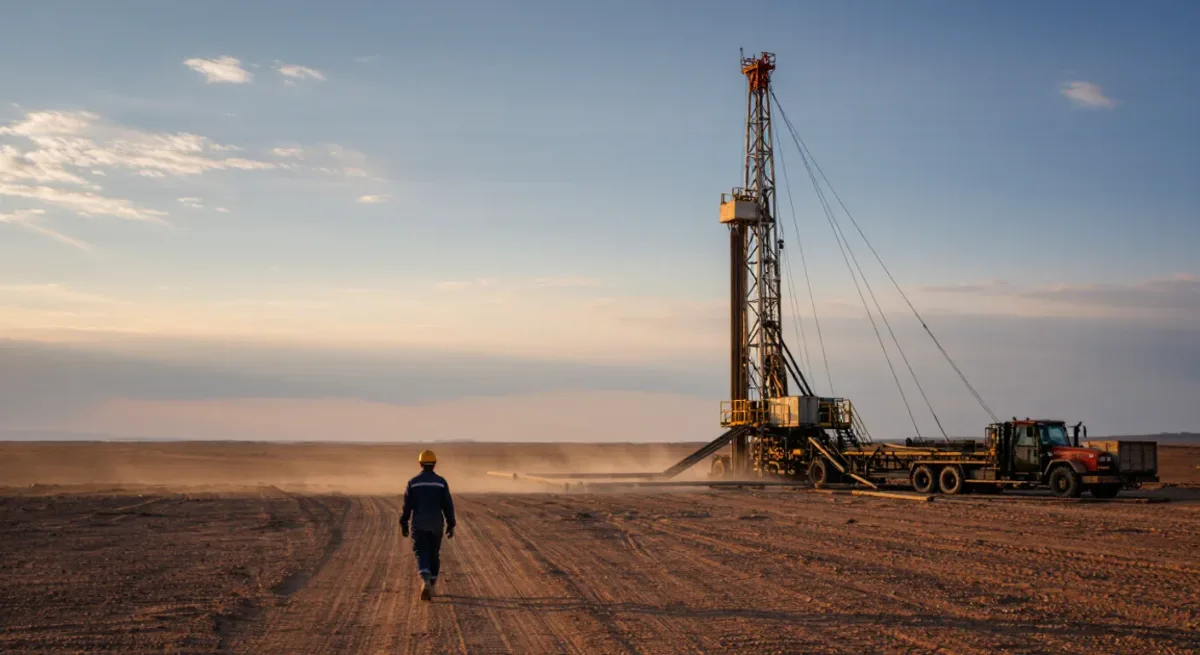
Vaca Muerta is a shale oil and gas formation the size of a small country — about 30,000 square kilometers of petroleum-rich rock beneath Neuquén province — and it has become the engine of Argentina's hydrocarbon output, supplying more than half of national crude production and reshaping the country's trade balance (Secretaría de Energía production data). The name, which means 'dead cow,' was stamped on maps by surveyors more than a century before anyone drilled it.
For an international reader trying to understand why Argentina keeps appearing in energy-market dispatches, the formation is the reason. Here is how it works, who runs it and what still stands in its way.
Why does one rock layer matter so much?
The Vaca Muerta formation is a Late Jurassic deposit of organic-rich shale that in places reaches several hundred meters of thickness — unusually generous by shale standards. Unlike conventional reservoirs, where oil pools in porous rock, the hydrocarbons here are locked inside the rock itself and must be released through hydraulic fracturing and horizontal drilling, the same techniques that rewrote the United States' energy position after 2008.
Argentina applied them at scale from roughly 2011, after YPF's discovery well at Loma La Lata Norte confirmed the play's potential. Well costs, which ran near 16 million dollars a well in the early years, have fallen by more than half as drilling moved to factory mode, and several operators now report core-area wells among the most productive outside North America (company filings and provincial data). That cost curve is the whole story of the play: Vaca Muerta only transforms Argentina's economics at a certain price of capital, and the industry has been marching down that curve for a decade.
Who actually operates there?
YPF, the state-controlled company, is the anchor operator and holds the biggest land position, including the Loma Campana joint venture with Chevron. Around it sits a genuinely international cast: ExxonMobil, Shell, Vista Energy, Tecpetrol (the Techint group company whose Fortín de Piedra gas development anchors dry-gas output), Pampa Energía, Pluspetrol and Canada's TC Energy on midstream, alongside a string of smaller explorers.
- Oil window: Loma Campana, La Amarga Chica and surrounding blocks drive the liquids growth that lifted Neuquén output past 400,000 barrels per day.
- Gas window: Fortín de Piedra and sister developments feed the national grid and exports to Chile.
- Midstream: the Presidente Néstor Kirchner gas pipeline, commissioned in 2023, broke the transport bottleneck that had stranded gas in the basin.
What did the pipeline change?
Before 2023, the basin could produce more gas than Argentina could move out of it, especially in winter, when Buenos Aires home heating claims priority. The new trunk line added several million cubic meters per day of takeaway capacity almost immediately, and its first stage let producers convert flared or shut-in volumes into revenue, export flows to Chile and a lower import bill for Bolivian gas and LNG. A second reinforcement loop remains on the industry's wish list and is the single most watched infrastructure decision in Argentine energy.
Can Argentina become an energy exporter?
The export thesis moved from slide decks to tankers in 2025, when a floating liquefaction venture backed by YPF, ExxonMobil and Excelerate Energy loaded Argentina's first LNG cargoes off Bahía Blanca. The volumes are small by world standards, but they proved the concept: Argentine molecules can reach the global market without a decade of onshore construction. Oil exports, meanwhile, already flow from the deepwater port of Punta Colorada, with most Atlantic-basin crude cargoes heading to Brazil, Europe and Asia.
The ceiling on all of this is capital. Full-basin development scenarios run to tens of billions of dollars over a decade, more than Argentina's restricted capital markets can fund domestically, which is why the Milei government built the RIGI investment-incentive regime to court international capital and why every IMF program review reads like an energy-financing document. The formation does not lack hydrocarbons; it lacks committed balance sheets.
What are the risks?
Three. Commodity prices: the play's breakevens are competitive in core areas but not immune to a sustained oil-price slide. Water and social license: fracking demands large water volumes in an arid province, and communities along the Colorado River track the industry closely. And macroeconomics: Argentina's currency and regulatory history makes long-cycle investors price in a premium, a discount that only consistent policy can remove.
None of these risks is hidden, and none is unique to Argentina. What distinguishes Vaca Muerta is that it is the only shale basin outside the United States and Canada that has demonstrably scaled — a fact that keeps it on the shortlist of every global oil-and-gas portfolio manager.
What the boom did to Neuquén
The basin's rise is measurable in the province it transformed. Neuquén's capital filled with oil-services offices, and Añelo — the town closest to the core blocks, population a few thousand when the shale era began — grew into a frontier camp with housing shortages, hotel occupancy running near permanent full, and the wage structure of a resource boom: rig hands and sand-truck drivers earning multiples of regional norms. Service companies built bases for hydraulic fracturing spreads; sand mines opened to supply proppant locally rather than importing it; and the provincial treasury's hydrocarbon royalties became the arithmetic behind public investment budgets.
Booms of this speed carry standard costs. Housing inflation priced out non-oil workers; road fatality and infrastructure wear tracked the truck traffic; and the towns absorbed waves of fly-in workers whose families stayed in the cities. Neuquén's governments have spent the royalty windfall on the classic list — housing, hospitals, roads — while economists caution that Argentine provinces have a long history of converting hydrocarbon cycles into recurring spending commitments. The province's own planners now talk explicitly about the Norwegian lesson: the discipline of converting a finite resource into durable assets rather than payroll.
For employment, the play has been most significant as an exporter of industrial competence. Neuquén's completion crews, drilling engineers and pad-construction logistics are now a hiring pool for unconventional projects worldwide, and the Argentine service diaspora — like the North Sea's before it — carries the basin's know-how to whichever shale frontier pays next.
To follow the company at the center of the play, read our profile of YPF, and for more coverage of the country's economy, explore the Argentina section.