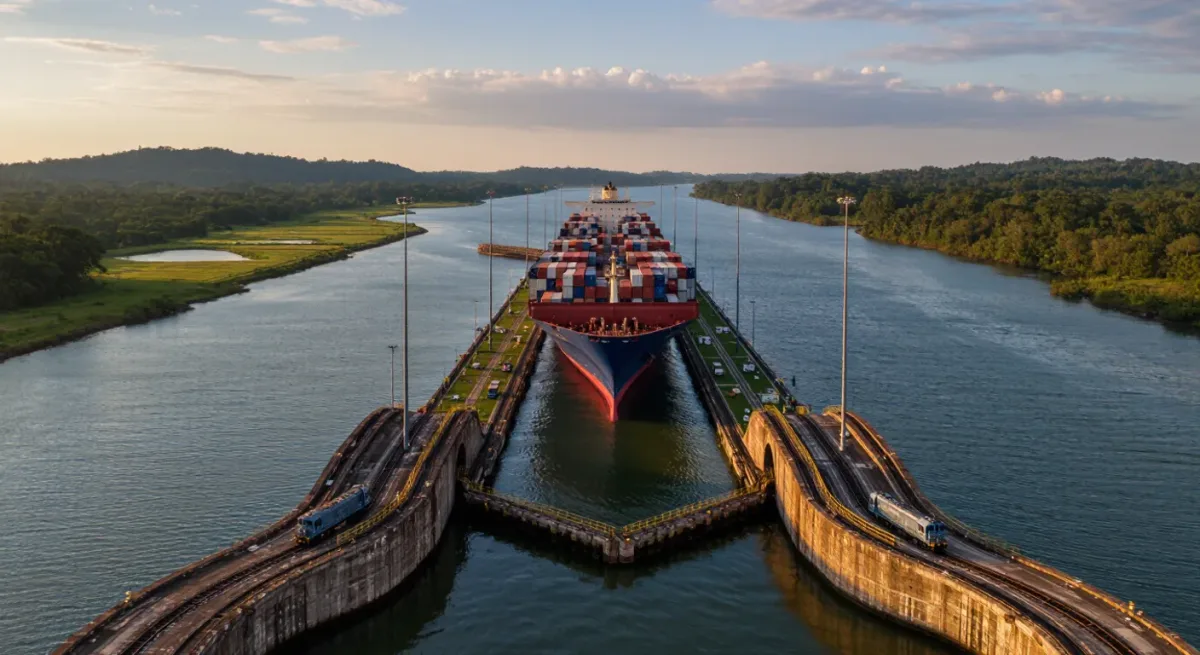
The Panama Canal moves roughly five percent of world maritime trade through a system whose engine is not machinery but rain: Gatún Lake, a rain-fed reservoir 26 meters above the sea that every transit both crosses and consumes — each passing ship lifts away fresh water in lockages and flushes it to the ocean. When drought dropped the lake in 2023, the canal authority cut daily transits from the standard 36 to as low as 22 and shrank the draft of ships; waiting times lengthened, and at the worst of it auction premiums for a transit slot reached into the millions of dollars per passage (Panama Canal Authority announcements; transit statistics).
Anatomy of the constraint
The canal's engineering miracle is also its hydrological fragility: the locks that lift ships to the lake and lower them again release about 50 million gallons of fresh water per transit for the largest vessels, and that water comes from the same watershed that supplies Panama City's taps. The canal expanded in 2016 with bigger locks for bigger ships — but the new lanes recycle part of their water, and the constraint that binds in a drought is the watershed's rainfall, not the concrete. The 2023 crisis arrived when El Niño-year rainfall failed: a canal built for a 1914 climate found that its water budget no longer clears in the 2020s' weather (ACP engineering reports).
- Normal capacity: 36 transits per day across the lock systems.
- Drought floor (late 2023): as low as 22 per day, with draft restrictions.
- Recovery: transit slots restored toward full capacity through 2024-2025 as rains returned.
- Response: a new reservoir project on the Indio river, approved in 2025, costed in the low billions.
What shippers did — and what it cost
The rerouting arithmetic was immediate. The alternatives to Panama are the Strait of Magellan or land bridges: US East Coast cargo via California or Mexico rail, Asia-bound LNG that simply cannot use the canal's old locks at all (most LNG carriers were already excluded by size), grain and chemical trades that switched to Suez where routing allowed. The 2024 Red Sea crisis then demonstrated the era's theme: every shortcut on earth can be squeezed at once, and freight markets reprice in days. The canal's own revenue paradox — record toll income in fiscal years when transits fell, because scarcity auctions monetized desperation — is a case study in infrastructure pricing the public-sector world rarely teaches (ACP financial reports).
The fix being built
The authority's answer to hydrology is more hydrology: the Indio river reservoir project, approved in 2025, would add storage and secure an additional tranche of daily transits in dry years, alongside water-saving deepening, cross-filling adjustments in the locks, and demand management through a new long-term slot allocation system that replaced first-come queues with booked commitments. The politics are nontrivial — the project displaces communities and crosses a river basin with its own constituents — but the alternative is a canal that rations the world's trade every El Niño. In the infrastructure century's vocabulary, Panama is climate-proofing its balance sheet (ACP project record).
| Measure | Drought floor vs normal |
|---|---|
| Daily transits | 22 vs 36 |
| Auction premium, peak | Millions of dollars per slot |
| Canal share of world trade | ~5% |
| Water per large transit | ~50 million gallons |
Why it matters beyond shipping desks
The canal is the region's clearest price tag on climate variability: a rain shortfall in one Central American watershed moved container rates, grain basis and LNG logistics worldwide. For Latin America's infrastructure agenda, it reframes every project's feasibility arithmetic — reservoirs, ports, hydroelectric dams — around the 2030s' rainfall distribution rather than the 1990s'. And for Panama itself, whose dollarized economy treats the canal's contributions as a fiscal pillar, the drought was a warning addressed directly to the sovereign: the goose that lays the golden transit fees drinks rain, and the rain is no longer reliable.
What to watch
Gatún Lake levels through each dry season; the Indio project's permitting and construction milestones; the long-term slot auction results, which reveal what guaranteed passage is actually worth to carriers; and the canal's fiscal-year toll decisions as it prices both scarcity and its cure. The 2023 crisis ended; the condition it revealed did not.
How scarcity was priced
The canal's slot-allocation system became, during the drought, one of the world's cleanest natural experiments in infrastructure pricing. Normal operations sell transit slots by booking classes; when water shortened supply, the authority's auction mechanism took over the marginal allocation, and carriers bid — the premiums that reached into the millions of dollars per passage were the market's honest price of the alternative, which was days of delay or weeks around the continent. Shippers with just-in-time cargo, perishables or contractual penalties bid hardest; those with flexible supply chains waited. Economists could not have designed a clearer demonstration that a canal is not a utility but a scarce asset whose value volatility had merely been hidden by decades of normal rainfall.
The post-drought reform converted that lesson into structure. The long-term slot allocation system — booking tiers with reliability commitments, priced to guarantee passage rather than to queue for it — trades some auction upside for schedule certainty, aligning the canal's revenue with the predictability shippers actually buy. The system's first years have been studied by every other chokepoint authority on earth, from Suez to the straits, for an obvious reason: the era of climate-vulnerable shortcuts has made Panama's drought a shared syllabus.
For how the region's airlines reorganized around different constraints, read our analysis of Latin American airline consolidation, and explore the Latin America business section.