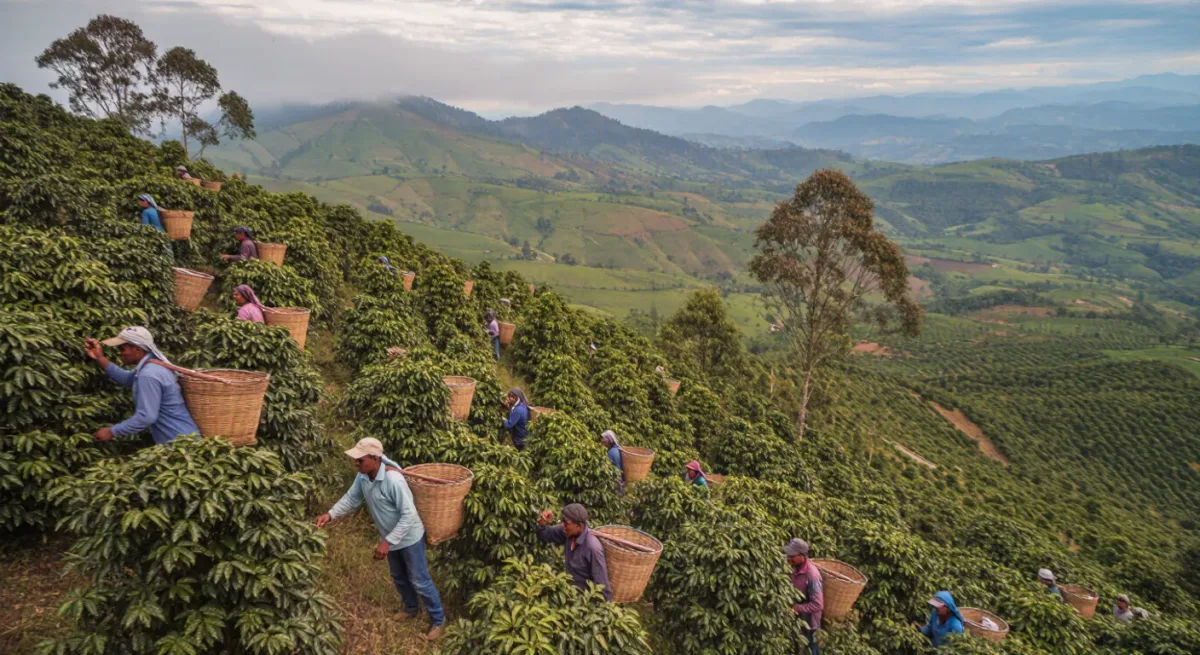
In the hills of Minas Gerais, which alone produces about half of Brazil's coffee, the harvest runs May through September, and the pickers' pace in those months sets a price millions of cafeterias and kitchens will pay the following year. That mechanism turned brutal recently: after drought stress and the memory of a severe frost damaged consecutive arabica crops, the New York futures price for arabica — the global benchmark — climbed above four dollars a pound, setting successive record highs and pulling retail coffee prices up across every continent (ICE futures data; CeCafé export statistics). Brazil's weather had become a line item in the world's cost of living.
Why one country moves the market
Arabica is a two-country crop in a way no other commodity quite matches: Brazil grows roughly a third of the world's coffee and a still larger share of its arabica, with Vietnam dominating the robusta alternative. Coffee trees are perennials with a biennial rhythm — a heavy year follows a light year — and the crop decides its size a year in advance, in the flowering and fruit-fill weather. A drought in Minas in year one shows up as a small harvest in year two and depleted trees in year three; the 2021 frost that killed young branches echoed through three subsequent harvests. The market, meanwhile, prices the future: when Brazil's crop forecasts fall, roasters bid for cover, and the futures curve does the rest (CONAB crop surveys; ICE data).
- Production: Brazil's output swings around 45-60 million 60-kg bags depending on the cycle and weather, with arabica around three-quarters of the total.
- Export value: coffee earns Brazil on the order of ten-plus billion dollars a year abroad (CeCafé).
- Benchmark: ICE arabica futures, priced in New York in cents per pound, are the world's reference price.
The domestic shock
Brazilians are the world's second or third-largest coffee drinkers per head, and the price shock reached their kitchens with unusual force: retail coffee inflation ran at rates that made it a household political topic, cafe menus repriced, and the traditional twice-a-day cafezinho habit absorbed what the sticker shock allowed. The government's response toolkit — mostly credit and storage support for growers — could not conjure weather, and roasters reformulated blends toward robusta and lower-grade lots where contracts allowed, a quiet quality adjustment the consumer tasted before the economics press explained it.
Who gains, who hurts
High prices are a transfer, not a windfall for everyone. Growers with full barns after a good harvest — and cooperatives holding stocks — captured generational prices; growers whose trees were droughted or frosted sold less volume at the high price, a bitter symmetry. Roasters and retailers absorbed margin compression they passed on unevenly; consumers everywhere paid more for a habit demand data says barely budges (coffee demand is famously inelastic — one reason the price could rise so far). The structural winners long-term are Brazilian producers with irrigated or high-altitude plots and financial staying power: high prices finance the replanting that raises the next decade's yields.
| Link in the chain | Effect of the price shock |
|---|---|
| Growers with stock | Record revenue |
| Growers with damaged trees | High prices, low volume |
| Roasters | Margin squeeze, blend reformulation |
| Consumers | Higher shelf prices, sticky demand |
What happens next
Coffee markets heal through supply response: high prices finance replanting and expansion — in Brazil, and in emerging origins from Vietnam's robusta to Ethiopian and Colombian arabica — with the classic multi-year lag of a tree crop. The biennial cycle alone guarantees some mean reversion; the weather does not guarantee anything. What the episode permanently changed is perception: roasters now hold inventory with a paranoia once reserved for oil, and 'Brazil risk' has entered the risk-management vocabulary of every multinational beverage company. The world's cheapest daily luxury, it turns out, was a leveraged bet on Minas Gerais rainfall all along.
The quality counter-current
Underneath the commodity drama, Brazil's coffee industry has spent two decades building a second economy on quality. The Cup of Excellence competitions and the specialty-cooperative movement reprice single farms' lots at multiples of the commercial price; experimental fermentation and processing — the natural, honey and anaerobic methods Brazilian producers systematized — turned the country's biggest industrial farms into the specialty world's most innovative laboratories; and the fine-cup segment gave Minas Gerais and the Cerrado Mineiro's denomination a direct-trade channel that bypasses the commodity cycle entirely. The volumes are a rounding error against Brazil's exports; the margin is not, and the segment's growth is the sector's structural answer to a question the price shock sharpened — what does a producer do when the commodity ladder's bottom rung is volatility?
The specialty tier also rewired the industry's geography of value. Direct-trade roasters in the United States, Europe and East Asia now contract with named Brazilian farms, paying for traceability, variety separation and process control; the certification and lab infrastructure that grading requires created a professional layer of Q-graders and quality analysts in the producing regions; and the knowledge flowed both ways — the agronomic precision once reserved for yield now serves cup scores. The high-price era has been, paradoxically, a tailwind: capital from record commodity revenues financed the lot separation and drying infrastructure that quality premiums require, converting a cycle's windfall into a permanent upgrade of the top tier's capacity.
For the other Brazilian crop that moves world prices, read our feature on the soy complex, and explore the Brazil section.